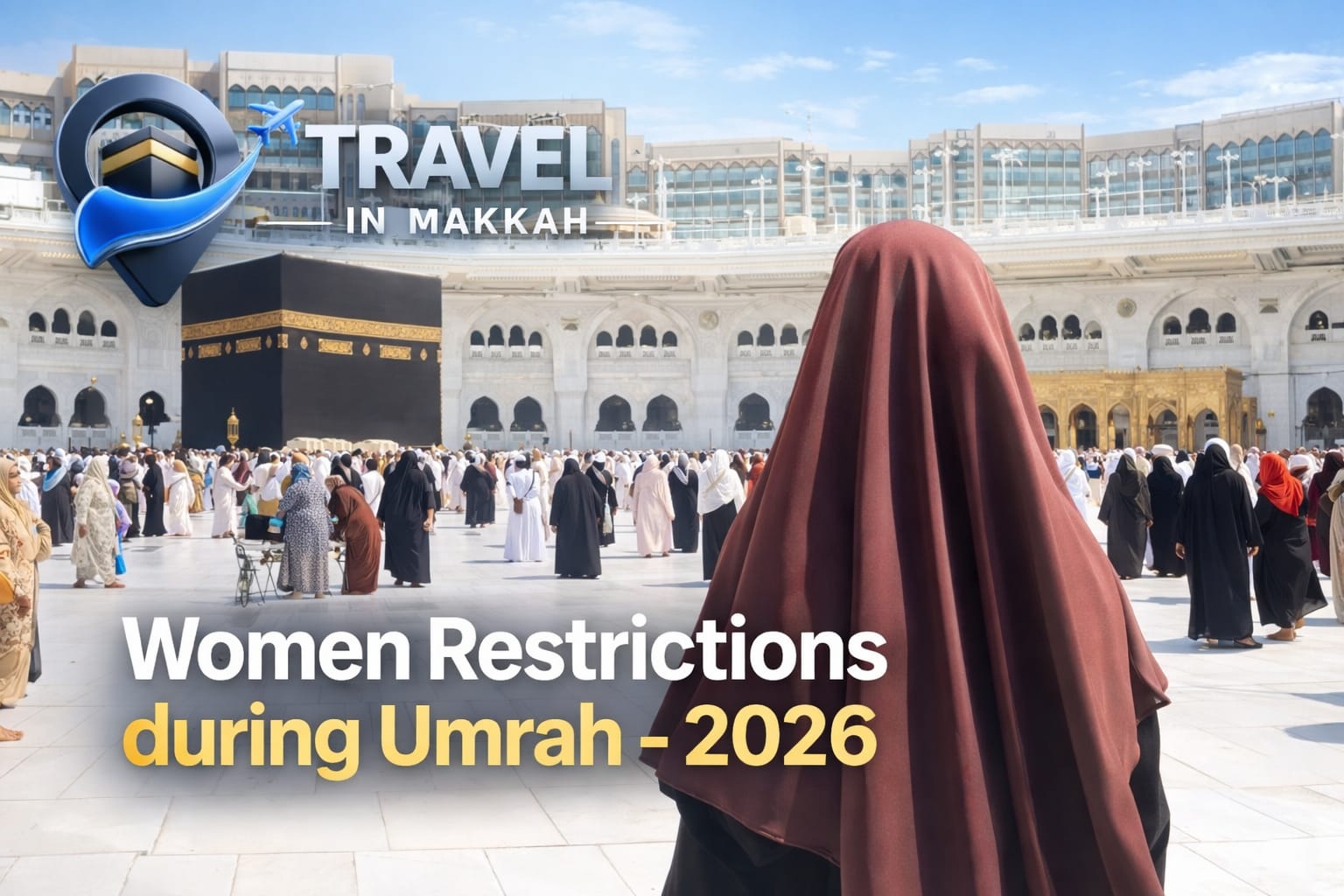
Women Restrictions During Umrah: Complete Guide for Female Pilgrims
For many Muslim women, performing Umrah is a dream filled with faith, hope, and deep spiritual emotion. It is a journey where a believer leaves behind worldly distractions and turns completely toward Allah. Every year millions of Muslims travel to Makkah to perform this sacred pilgrimage, seeking forgiveness and spiritual purification.
Although the rituals of Umrah are generally the same for both men and women, Islam provides specific guidelines and restrictions for female pilgrims. These rules are rooted in the Qur’an, authentic Hadith, and scholarly interpretations, and they are designed to preserve modesty, dignity, and spiritual focus.
Understanding these restrictions helps women perform Umrah correctly and confidently. In this guide, we explain the main religious restrictions for women during Umrah, supported by Arabic Islamic evidence and modern Saudi regulations.
Table of Contents
- Women Restrictions During Umrah: Complete Guide for Female Pilgrims
- Islamic Evidence About Modesty During Pilgrimage
- Ihram Rules for WomenClothing Guidelines During Ihram
- Restrictions During Ihram
- Hadith About Women in Ihram
- Guidelines for Women During Tawaf
- Rules for Sa’i Between Safa and Marwah
- Hair Trimming After Completing Umrah
- Menstruation Rules During Umrah
- Traveling for Umrah Without a Mahram
- Saudi Visa Rules for Women (2025–2026)
- Practical Tips for Women Performing Umrah
- Conclusion
Islamic Evidence About Modesty During Pilgrimage
Islam emphasizes modesty, humility, and purity during acts of worship. Allah سبحانه وتعالى reminds believers in the Qur’an:
وَأَتِمُّوا الْحَجَّ وَالْعُمْرَةَ لِلَّهِ
“And complete the Hajj and Umrah for Allah.”
(Surah Al-Baqarah 2:196)
This verse clearly shows that both Hajj and Umrah must be performed sincerely for Allah alone and according to the prescribed rules.
Another verse highlights the importance of modesty during worship:
يَا بَنِي آدَمَ خُذُوا زِينَتَكُمْ عِندَ كُلِّ مَسْجِدٍ وَكُلُوا وَاشْرَبُوا وَلَا تُسْرِفُوا
“O children of Adam, take your adornment at every masjid, and eat and drink but do not be excessive.”
(Surah Al-A‘raf 7:31)
Classical scholars such as Ibn Kathir explain that this verse encourages modest dress and discourages extravagance during acts of worship such as Hajj and Umrah.
Ihram Rules for Women
Before entering Makkah, every pilgrim must enter the sacred state known as Ihram at a designated boundary called Miqat.
Women begin Ihram by making niyyah (intention) and reciting the Talbiyah:
لَبَّيْكَ اللَّهُمَّ لَبَّيْكَ، لَبَّيْكَ لَا شَرِيكَ لَكَ لَبَّيْكَ، إِنَّ الْحَمْدَ وَالنِّعْمَةَ لَكَ وَالْمُلْكَ، لَا شَرِيكَ لَكَ
“Here I am, O Allah, here I am. Here I am, You have no partner, here I am. Indeed, all praise, blessings, and sovereignty belong to You. You have no partner.”
Unlike men, women do not have a fixed Ihram garment. They may wear any modest clothing that covers the body properly.
Clothing guidelines during Ihram
Women should wear clothing that:
- Covers the entire body except the face and hands
- Is loose and not transparent
- Is modest and simple
Islamic jurists, including scholars of the Shafi‘i school, allow women to wear garments such as abaya or jilbab during Ihram.
Restrictions during Ihram
Women in Ihram must avoid:
- Wearing perfume or scented cosmetics
- Wearing gloves
- Covering the face with a niqab
- Cutting hair or nails
- Using scented soaps or lotions
- Engaging in arguments or disputes
These restrictions help maintain humility and spiritual discipline during pilgrimage.
Hadith About Women in Ihram
The Prophet Muhammad ﷺ clearly explained the restrictions for women during Ihram.
He said:
لَا تَنْتَقِبُ الْمَرْأَةُ الْمُحْرِمَةُ وَلَا تَلْبَسُ الْقُفَّازَيْنِ
“A woman in the state of Ihram should not wear a niqab or gloves.”
(Sahih al-Bukhari, Hadith 1818)
Another narration confirms the same ruling:
لَا تُغَطِّي الْمُحْرِمَةُ وَجْهَهَا وَلَا تَلْبَسُ الْقُفَّازَيْنِ
“The woman in Ihram should not cover her face or wear gloves.”
(Sahih Muslim, Hadith 1182)
These hadiths are the primary evidence used by scholars when explaining the dress restrictions for women during Umrah.
Guidelines for Women During Tawaf
One of the most important rituals of Umrah is Tawaf, which involves walking around the Kaaba seven times.
Women perform Tawaf in the same way as men but should observe certain guidelines.
Maintaining modesty in crowded areas
Because the area around the Kaaba can become crowded, women should try to avoid pushing through large crowds and maintain modesty as much as possible.
Many female pilgrims choose to perform Tawaf on the upper levels of Masjid al-Haram, where the environment is less crowded and safer.
Ritual purity requirement
Women must be in a state of ritual purity when performing Tawaf.
If a woman is menstruating, she should delay Tawaf until purification is completed.
Rules for Sa’i Between Safa and Marwah
After completing Tawaf, pilgrims perform Sa’i, which involves walking seven times between the hills of Safa and Marwah.
This ritual commemorates the struggle of Hajar (RA) when she searched for water for her son Prophet Ismail (AS).
Women perform Sa’i the same way as men with one small difference.
Men run between the green markers, while women walk at a normal pace throughout the entire ritual.
Hair Trimming After Completing Umrah
The final step of Umrah is Taqsir, which means trimming the hair.
Men may shave their heads, but women are not permitted to shave their hair.
Instead, women cut a small portion of their hair—approximately the length of a fingertip—from the ends of their hair.
Once this step is completed, the pilgrim exits the state of Ihram and the Umrah is finished.
Menstruation Rules During Umrah
Menstruation is an important issue for female pilgrims.
Women who are menstruating cannot perform Tawaf, because this ritual requires purity.
However, they can still:
- Recite dua
- Engage in dhikr (remembrance of Allah)
- Perform Sa’i
After the menstrual cycle ends and the woman performs ghusl (ritual purification), she can return to the Haram and complete Tawaf.
Traveling for Umrah Without a Mahram
Traditionally, Islamic scholars encouraged women to travel with a Mahram, a male guardian such as a father, husband, or brother.
The Prophet ﷺ said:
لَا تُسَافِرُ الْمَرْأَةُ إِلَّا مَعَ ذِي مَحْرَمٍ
“A woman should not travel except with a Mahram.”
(Sahih al-Bukhari)
However, modern travel regulations in Saudi Arabia have changed.
According to recent policies introduced by the Saudi government, women aged 18 years and above may perform Umrah without a Mahram when traveling through licensed tour groups or official travel platforms.
Saudi Visa Rules for Women (2025–2026)
Saudi Arabia has simplified the Umrah process through the Nusuk digital platform, which allows pilgrims to book services and obtain permits online.
Women can now apply for Umrah independently.
Typical requirements include:
- A valid passport with at least six months validity
- Vaccination requirements
- Travel insurance
- Confirmed accommodation booking
- Umrah permit through Nusuk
Official platforms providing verified information include:
Ministry of Hajj and Umrah
Nusuk Platform
Saudi Tourism Portal
These official websites provide updated information about visas, travel regulations, and Umrah services.
Practical Tips for Women Performing Umrah
Proper preparation can make the Umrah journey easier and more comfortable for female pilgrims.
Women are encouraged to:
- Choose accommodation near Masjid al-Haram
- Carry comfortable walking shoes
- Stay hydrated during Tawaf and Sa’i
- Carry essential items such as water, sanitizer, and tissues
- Travel with trusted companions or organized groups
These preparations help pilgrims focus more on worship and less on logistical challenges.
Conclusion
Umrah is a powerful spiritual journey for Muslim women. It is an opportunity to seek forgiveness, strengthen faith, and reconnect with Allah.
By understanding the religious restrictions and guidelines related to Umrah—such as modest dress, Ihram rules, Tawaf etiquette, and travel regulations—female pilgrims can perform their pilgrimage with confidence and devotion.
With sincerity, patience, and trust in Allah, the journey of Umrah becomes a deeply transformative experience that brings the believer closer to her Creator.
Read More: Explore everything you need for your sacred journey at Travel in Makkah. Start from our homepage to get a complete overview, then visit our Shop page to find essential travel items for Hajj and Umrah. Learn more about our mission and services on the About page, and read helpful guides and updates on our Blog to prepare yourself better. When you're ready, you can easily book your journey through our booking page and begin your spiritual experience with confidence.
Written by
Travel in Makkah
Sharing insights about pilgrimage, spiritual journeys, and sacred travel experiences.