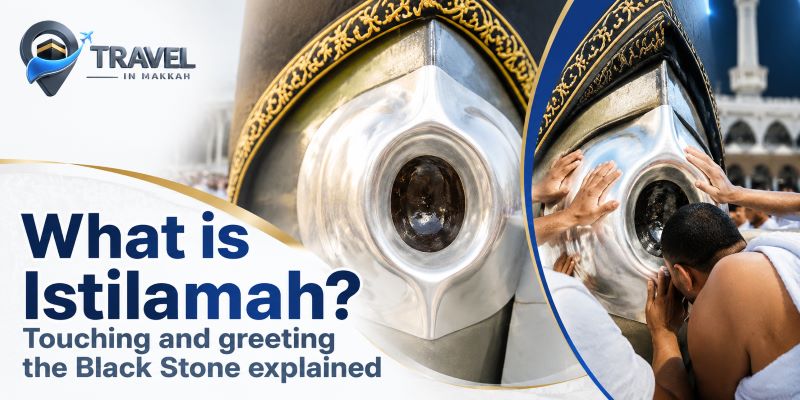
What is Istilamah? Touching and Greeting the Black Stone Explained
Learn what Istilamah means in Tawaf, how to greet the Black Stone correctly, what to say, and the authentic hadith evidence behind this Sunnah.
Introduction
Many first-time pilgrims hear the word Istilamah during Umrah or Hajj, especially when learning how to perform Tawaf around the Kaaba. Some people think Istilamah only means kissing the Black Stone, while others think they must physically touch it for their Tawaf to be accepted.
But what is Istilamah in Islam?
Istilamah means greeting, touching, kissing, or gesturing toward the Black Stone — الحجر الأسود / Al-Hajar al-Aswad — during Tawaf, according to what is possible and safe. It is a beautiful Sunnah of the Prophet Muhammad ﷺ, but it must be done with correct understanding, humility, and without harming other pilgrims.
This guide explains the meaning of Istilamah, how to do it correctly, what to say, the authentic hadith evidence, and the common mistakes pilgrims should avoid.

What Does Istilamah Mean?
The Arabic word is:
استلام الحجر الأسود
Istilām al-Hajar al-Aswad
Meaning: to touch, greet, or acknowledge the Black Stone during Tawaf.
In the context of Hajj and Umrah, Istilamah usually refers to one of the following actions when a pilgrim reaches the Black Stone corner:
- Kissing the Black Stone directly, if possible.
- Touching it with the hand and kissing the hand.
- Touching it with a stick or object and kissing that object.
- Pointing toward it from a distance and saying Allāhu Akbar if touching is not possible.
The most important point is this: Istilamah is Sunnah, not a condition for Tawaf. Your Tawaf is valid even if you cannot touch or kiss the Black Stone.
What is the Black Stone?
The Black Stone is called:
الحجر الأسود
Al-Hajar al-Aswad
It is located in the eastern corner of the Kaaba. Tawaf begins from the line of the Black Stone, and each round of Tawaf starts when the pilgrim comes in line with it.
Muslims do not worship the Black Stone. It is honored because Allah allowed it to be part of the rites of Tawaf, and the Prophet Muhammad ﷺ touched and kissed it.
This distinction is very important. Muslims worship Allah alone. The Black Stone cannot benefit or harm anyone by itself.
Strong Evidence for Istilamah from Hadith
1. The Prophet ﷺ Kissed the Black Stone
It is authentically reported that the Prophet ﷺ kissed the Black Stone.
Ibn Umar رضي الله عنهما reported:
أَنَّ رَسُولَ اللَّهِ ﷺ قَبَّلَ الْحَجَرَ الأَسْوَدَ
Meaning: The Messenger of Allah ﷺ kissed the Black Stone.
Reference: Sahih al-Bukhari and Sahih Muslim
This proves that kissing the Black Stone is a Sunnah when it can be done without pushing, fighting, or harming others.
2. Umar ibn al-Khattab’s Famous Statement
Umar ibn al-Khattab رضي الله عنه kissed the Black Stone and said:
إِنِّي أَعْلَمُ أَنَّكَ حَجَرٌ، لاَ تَضُرُّ وَلاَ تَنْفَعُ، وَلَوْلاَ أَنِّي رَأَيْتُ النَّبِيَّ ﷺ يُقَبِّلُكَ مَا قَبَّلْتُكَ
Meaning: I know that you are only a stone. You cannot harm or benefit. If I had not seen the Prophet ﷺ kissing you, I would not have kissed you.
Reference: Sahih al-Bukhari and Sahih Muslim
This hadith teaches two major lessons:
First, Muslims kiss the Black Stone only because the Prophet ﷺ did so. Second, we do not believe the stone itself has independent power. Benefit and harm belong to Allah alone.
3. Pointing to the Black Stone is Allowed
When the Prophet ﷺ performed Tawaf while riding, he pointed toward the Black Stone.
Ibn Abbas رضي الله عنهما reported that the Prophet ﷺ performed Tawaf on his camel, and whenever he came to the Black Stone, he pointed toward it with something he had and said:
اللَّهُ أَكْبَرُ
Allāhu Akbar
Meaning: Allah is the Greatest.
Reference: Sahih al-Bukhari
This hadith is very practical for today’s pilgrims. Because the area around the Black Stone is often crowded, many pilgrims cannot reach it safely. In that case, simply face or point toward it and say, Allāhu Akbar.
How to Do Istilamah Correctly
When you reach the Black Stone during Tawaf, follow one of these methods depending on the situation.
Method 1: Kiss the Black Stone Directly
If the area is calm and you can reach the Black Stone without pushing or harming anyone, you may kiss it directly.
This is the most complete form of Istilamah. However, in modern Hajj and Umrah crowds, this is often difficult.
Method 2: Touch It with Your Hand and Kiss Your Hand
If you can touch the Black Stone with your hand but cannot kiss it directly, you may touch it and then kiss your hand.
This is also based on the practice of the Prophet ﷺ and the Companions.
Method 3: Touch It with an Object and Kiss the Object
If someone touches the Black Stone with a stick or similar object and then kisses that object, this is also mentioned in authentic reports.
However, today this is usually not practical because of crowd control and safety rules.
Method 4: Point Toward It and Say “Allāhu Akbar”
This is the safest and easiest method for most pilgrims today.
When you come in line with the Black Stone, raise your hand slightly toward it and say:
اللَّهُ أَكْبَرُ
Allāhu Akbar
Meaning: Allah is the Greatest.
You do not need to kiss your hand after pointing. Many pilgrims mistakenly point toward the Black Stone and then kiss their hands. Kissing the hand is only done when the hand actually touches the Black Stone.
What Should You Say During Istilamah?
The most authentic phrase to say when reaching or pointing toward the Black Stone is:
اللَّهُ أَكْبَرُ
Allāhu Akbar
Meaning: Allah is the Greatest.
Some scholars also mention saying:
بِسْمِ اللَّهِ وَاللَّهُ أَكْبَرُ
Bismillāhi wallāhu Akbar
Meaning: In the name of Allah, and Allah is the Greatest.
However, the clearly established wording from authentic hadith is Allāhu Akbar.
A pilgrim should avoid invented phrases or believing that a specific long dua must be said at the Black Stone. Tawaf is a time for dhikr, dua, Qur’an recitation, and humility, but there is no need to force unauthentic formulas.
Is Istilamah Required for Tawaf?
No. Istilamah is not required for Tawaf to be valid.
Tawaf remains valid even if you only point toward the Black Stone from far away, or even if you miss pointing because of crowd pressure.
The core obligation is to complete seven rounds around the Kaaba in the correct manner. Istilamah is a Sunnah connected to each round, but it is not a condition of Tawaf.
This is especially important for elderly pilgrims, women, children, and anyone who may be harmed in the crowd. Islam does not command a pilgrim to harm others just to reach the Black Stone.
Should Women Try to Touch or Kiss the Black Stone?
Women may perform Istilamah if it can be done safely, modestly, and without mixing in a harmful crowd. However, in most busy times, it is better and safer for women to point from a distance and say, Allāhu Akbar.
The same advice applies to elderly pilgrims, weak pilgrims, and anyone traveling with children. Safety, modesty, and avoiding harm are more important than trying to physically reach the Black Stone.
The Prophet ﷺ said:
لاَ ضَرَرَ وَلاَ ضِرَارَ
Lā ḍarar wa lā ḍirār
Meaning: There should be neither harming nor reciprocating harm.
This principle is widely used by scholars in Islamic law. So if touching the Black Stone causes pushing, injury, argument, or harm, then it should be avoided.
Istilamah in Each Round of Tawaf
Tawaf has seven rounds. Each round begins from the Black Stone line.
When you reach the Black Stone at the beginning of each round, you should do Istilamah according to what is possible:
If you can kiss it safely, kiss it.
If you can touch it safely, touch it and kiss your hand.
If you cannot reach it, point toward it and say, Allāhu Akbar.
After completing the seventh round, you will also come back to the Black Stone line. Many scholars mention doing Istilamah there as well, because it marks the completion point.
What About the Yemeni Corner?
The Yemeni Corner is called:
الرُّكْن اليَمَانِي
Ar-Rukn al-Yamānī
It is the corner before the Black Stone. The Prophet ﷺ used to touch the Yemeni Corner when possible.
However, there is an important difference:
For the Black Stone, you may kiss it, touch it, or point toward it.
For the Yemeni Corner, you only touch it if possible. If you cannot touch it, you do not point toward it.
Also, the Yemeni Corner is not kissed. Many pilgrims mistakenly kiss their hand after pointing to the Yemeni Corner. This is not from the Sunnah.
Between the Yemeni Corner and the Black Stone, it is Sunnah to recite:
رَبَّنَا آتِنَا فِي الدُّنْيَا حَسَنَةً، وَفِي الآخِرَةِ حَسَنَةً، وَقِنَا عَذَابَ النَّارِ
Rabbanā ātinā fid-dunyā ḥasanah, wa fil-ākhirati ḥasanah, wa qinā ‘adhāban-nār.
Meaning: Our Lord, give us good in this world and good in the Hereafter, and protect us from the punishment of the Fire.
This dua is from the Qur’an, Surah al-Baqarah 2:201.
Common Mistakes During Istilamah
1. Pushing Others to Reach the Black Stone
This is one of the biggest mistakes. A Sunnah should not be done by committing harm. Pushing, shouting, elbowing, or stepping on others goes against the spirit of worship.
2. Thinking Tawaf is Invalid Without Kissing the Black Stone
This is incorrect. Tawaf is valid without kissing or touching the Black Stone. Pointing and saying Allāhu Akbar is enough when you cannot reach it.
3. Worshipping or Seeking Blessing from the Stone Itself
Muslims honor the Black Stone because the Prophet ﷺ honored it. But the stone itself does not control benefit, harm, forgiveness, or answered dua. Only Allah does.
4. Kissing the Hand After Only Pointing
If you only point toward the Black Stone, you do not kiss your hand. Kissing the hand is only done when the hand actually touches the Black Stone.
5. Pointing to the Yemeni Corner
The Yemeni Corner is touched if possible. If you cannot touch it, you simply continue Tawaf. You do not point toward it.
6. Making Istilamah a Photo or Video Moment
The Black Stone is connected to worship, humility, and following the Sunnah. Turning it into a selfie moment can distract from the purpose of Tawaf.
Spiritual Meaning of Istilamah
Istilamah is not just a physical action. It is a moment of obedience.
When a believer kisses, touches, or points toward the Black Stone, he is saying through his action: “O Allah, I follow the way of Your Prophet ﷺ.”
Umar رضي الله عنه understood this deeply. He knew the stone itself could not benefit or harm. Yet he kissed it because he saw the Prophet ﷺ doing so. That is the heart of Sunnah: loving obedience, not blind superstition.
Istilamah reminds the pilgrim that Islam is built on revelation, not personal emotion. We do what the Prophet ﷺ taught, in the way he taught it, without exaggeration and without negligence.
Practical Advice for Pilgrims
If you are performing Umrah or Hajj today, the safest method is often to point toward the Black Stone and say, Allāhu Akbar.
Do not feel sad if you cannot touch it. Allah knows your intention. A safe, calm, and humble Tawaf is better than a stressful Tawaf filled with pushing and arguments.
If the area is empty and you can approach safely, then kissing or touching the Black Stone is a blessed Sunnah. But if there is a crowd, avoid harm and follow the easier Sunnah of pointing.
Remember: the reward is in following the Prophet ﷺ, not in fighting your way through people.
FAQ About Istilamah
What is Istilamah in simple words?
Istilamah means greeting the Black Stone during Tawaf by kissing it, touching it, or pointing toward it and saying, Allāhu Akbar.
Is kissing the Black Stone compulsory?
No. Kissing the Black Stone is Sunnah, not compulsory. If you cannot reach it safely, point toward it and say, Allāhu Akbar.
What do you say when pointing to the Black Stone?
You say:
اللَّهُ أَكْبَرُ
Allāhu Akbar
Meaning: Allah is the Greatest.
Can I kiss my hand after pointing to the Black Stone?
No. You kiss your hand only if your hand actually touched the Black Stone. If you only point from a distance, say Allāhu Akbar and continue Tawaf.
Does the Black Stone forgive sins?
The Black Stone itself does not forgive sins. Only Allah forgives sins. Muslims honor the Black Stone because the Prophet ﷺ honored it.
Can women touch or kiss the Black Stone?
Women may do so if it is safe, modest, and without harmful crowding. In busy times, it is better to point from a distance and say, Allāhu Akbar.
What is the difference between the Black Stone and the Yemeni Corner?
The Black Stone may be kissed, touched, or pointed to. The Yemeni Corner is only touched if possible. If you cannot touch the Yemeni Corner, you do not point to it.
Conclusion
Istilamah is the Sunnah act of greeting the Black Stone during Tawaf. It may be done by kissing the Black Stone, touching it and kissing the hand, touching it with an object, or simply pointing toward it and saying Allāhu Akbar.
The strongest lesson of Istilamah is not about reaching a stone; it is about following the Prophet Muhammad ﷺ with love, humility, and correct belief.
A pilgrim should never push, fight, or harm others to kiss the Black Stone. If touching it is easy and safe, it is a beautiful Sunnah. If not, pointing from a distance is enough.
The Black Stone is honored, but it is not worshipped. Muslims worship Allah alone. Istilamah is an act of obedience to Allah and love for the Sunnah of His Messenger ﷺ.
visit our home page.
Written by
admin
Sharing insights about pilgrimage, spiritual journeys, and sacred travel experiences.