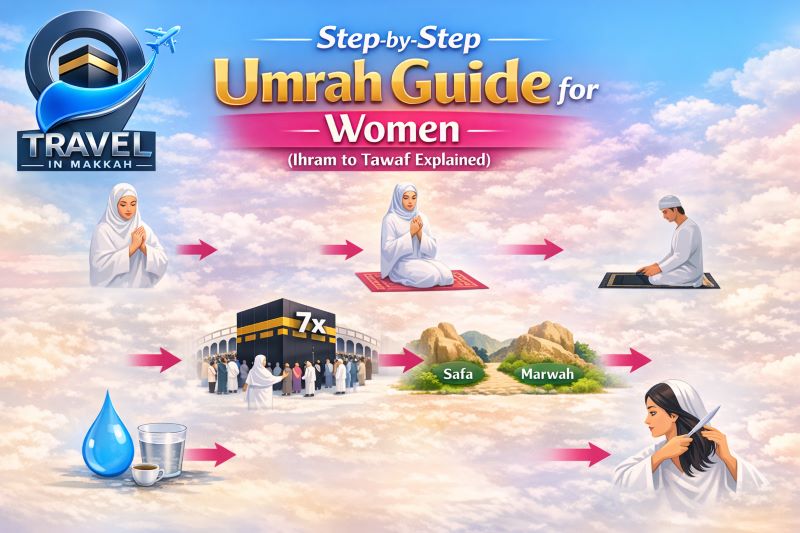
Step-by-Step Umrah Guide for Women (Ihram to Tawaf Explained)
Umrah is a beautiful act of worship in which a Muslim visits the Sacred House in Makkah, performs tawaf around the Kaaba, walks between Safa and Marwah, and then exits ihram by shortening the hair. The Saudi Ministry of Hajj and Umrah defines Umrah in this way, and Allah says, “And complete the Hajj and ‘Umrah for Allah.”
For women, Umrah follows the same main pillars as men, but some rulings and practical concerns are different. Clothing rules are different. Face-covering details are different. Crowd safety matters more. Menstruation rulings also affect when tawaf can be done. That is why many women need a practical guide written specifically for them, not just a general Umrah article. This guide separates the religious rulings from the practical travel guidance so first-time pilgrims can follow it clearly and confidently.
What Is Umrah in simple words?
In simple words, Umrah is the minor pilgrimage to Makkah. It includes entering ihram with intention, performing seven circuits of tawaf around the Kaaba, praying after tawaf, doing seven laps of Sa‘i between Safa and Marwah, and then shortening the hair to come out of ihram. It can be performed throughout the year, unlike Hajj which has fixed days.
Why women need a separate practical guide
A woman in ihram does not wear the same special two-cloth garment as a man. The Prophet ﷺ also specifically forbade a woman in ihram from wearing a niqab and gloves. At the same time, trusted scholars such as Shaykh Ibn Baz explained that she may still lower part of her khimar or jilbab over her face when non-mahram men are around. Menstruation also does not stop a woman from entering ihram, but it does stop tawaf until she becomes pure. Those details are exactly why women need a separate guide.
Before you start: intention and preparation
Before travel, learn the basic rulings of Umrah properly. The Ministry’s official guide itself advises pilgrims to review the correct description and rulings of Umrah before travel. It also directs pilgrims to check visa, permit, vaccinations, and legal travel documents in advance.
For current travel logistics, the Saudi official guidance says Umrah services, visa channels, and booking support are available through official platforms such as Nusuk Umrah and the Saudi visa system. The Ministry FAQ and guide also indicate that Umrah permits are handled through Nusuk and that registration requires items such as passport details, visa number, nationality, date of birth, mobile number, and email. Because app rules and entry procedures can change, verify them again shortly before departure through the official Saudi sources.
Regarding the mahram issue, the current official KSA Visa Umrah details page says women do not require a male guardian to accompany them for Umrah. Still, because visa and country-specific processing can change, it is wise to re-check your own nationality’s rules before booking.
Step 1: Entering Ihram for Umrah
Ihram begins when the woman makes the intention for Umrah at or before the miqat. The Ministry’s guide says the intention is made in the heart when aligning with the miqat, and if arriving first through Jeddah by plane, the pilgrim should enter ihram on the aircraft when it is announced that the plane is passing the miqat.
The intention itself is in the heart. It is not required to create a long spoken formula. Many pilgrims simply say:
لَبَّيْكَ اللَّهُمَّ عُمْرَةً
Here I am, O Allah, for Umrah.
Then begin the Talbiyah. The well-known Talbiyah taught by the Prophet ﷺ is:
لَبَّيْكَ اللَّهُمَّ لَبَّيْكَ، لَبَّيْكَ لَا شَرِيكَ لَكَ لَبَّيْكَ، إِنَّ الْحَمْدَ وَالنِّعْمَةَ لَكَ وَالْمُلْكَ، لَا شَرِيكَ لَكَ
Here I am, O Allah, here I am. Here I am, You have no partner, here I am. Truly all praise, favor, and dominion belong to You. You have no partner.
Women recite Talbiyah, but they do not need to raise their voices in a way that draws attention or disturbs others. A quiet, modest recitation is best. This is a practical application of modesty and calmness in worship, especially in crowded environments.
Can a woman enter ihram while menstruating?
Yes. A woman can enter ihram while menstruating. This is one of the most important rulings for women. When ‘Aishah رضي الله عنها began menstruating, the Prophet ﷺ told her to do what the pilgrims do, except not to perform tawaf until she became pure. That means menstruation does not cancel or prevent ihram itself; it only delays tawaf.
Step 2: Ihram clothing rules for women
The official Ministry guide states that a woman in ihram wears whatever permissible and modest clothing she wishes, without adornment. This means there is no special two-piece ihram cloth for women. She may wear regular modest clothing that covers properly.
A practical list for women in ihram:
- loose, modest clothing
- proper hijab
- non-decorative dress or abaya
- comfortable walking footwear
- no beautification meant for display
What to avoid:
- perfume on clothing after entering ihram
- adornment and unnecessary beautification
- cutting hair or nails after entering ihram until Umrah is completed
- sexual intimacy and its preludes during ihram
Niqab and gloves ruling during ihram
This ruling is specific and important. The Prophet ﷺ said:
وَلَا تَنْتَقِبُ الْمَرْأَةُ الْمُحْرِمَةُ وَلَا تَلْبَسُ الْقُفَّازَيْنِ
A woman in ihram should not wear niqab or gloves.
So the correct rule is:
- she should not wear a fitted niqab
- she should not wear gloves
- but she may cover herself modestly in other permissible ways
Can women cover the face in front of men?
Yes, according to the scholarly explanation cited above, the prohibition is on the niqab itself as a face-shaped covering in ihram, not on all face-covering in every situation. Shaykh Ibn Baz explained that a woman may lower part of her khimar, jilbab, or similar garment over her face when non-mahram men are present. This is an important distinction and corrects a very common misunderstanding.
Step 3: Arrival in Makkah and entering Masjid al-Haram
The official Saudi Umrah guide includes maps, gate guidance, mobility access points, and crowd-flow instructions. It notes that the mataf ground floor is designated for those in ihram, while upper levels may also be used for tawaf. It also highlights carts and wheelchair arrangements on designated floors.
When you enter Masjid al-Haram, remain calm. The official guidance repeatedly stresses gentleness, tranquility, avoiding congestion, and moving with the direction of the crowd. It also advises pilgrims not to create disturbance through crowding or distractions such as excessive photography. For women, this advice is especially valuable. Choose a route and level that protects modesty, reduces pressure, and helps you worship with khushu‘.
What to do at first sight of the Kaaba
There is no sahih hadith establishing a special fixed du‘a that must be said the moment one first sees the Kaaba. So do not feel guilty if you do not find one. Instead, praise Allah, make sincere du‘a in your own words, send salawat upon the Prophet ﷺ, and prepare for tawaf with humility. This is more honest and safer than following unauthenticated viral supplication lists. The official guides emphasize remembrance and humility, not loud scripted formulas.
Step 4: How women perform Tawaf
Tawaf is done by circling the Kaaba seven times, starting at the Black Stone and ending at it. The official Ministry guide says to begin tawaf in line with the Black Stone, move gently with the crowds, and avoid walking against the direction or causing congestion. Bukhari also records the Prophet’s tawaf around the House and the sequence leading into prayer and Sa‘i.
Number of circuits
Seven circuits. Not six. Not “about seven.” The Umrah is not complete unless the circuits are completed properly.
Where tawaf starts and ends
It starts in line with al-Hajar al-Aswad and every circuit ends there. The Prophet ﷺ pointed toward the Black Stone and said Allahu Akbar when he came to it.
You may say:
اللَّهُ أَكْبَرُ
Allah is the Greatest.
Should women kiss or touch Hajar al-Aswad?
Women should not push, harm others, or expose themselves to crowd pressure just to kiss or touch the Black Stone. The Sunnah is to point toward it and say Allahu Akbar when crowding makes access difficult. Official Saudi guidance also tells pilgrims to move gently and avoid congestion. That is especially relevant for women in busy mataf conditions.
Crowd safety and modesty guidance for women
In crowded conditions:
- choose a less congested area or upper floor
- do not force your way to the Black Stone
- remain with a trusted group if possible
- set a meeting point before tawaf
- keep valuables secure
- prioritize modesty, calmness, and safety over getting close to the Kaaba walls
What duas or dhikr may be read in tawaf?
There is no authentic fixed du‘a for each of the seven rounds. That popular practice is widespread, but the stronger evidence does not establish a separate prescribed du‘a for every circuit. This is why many official and scholarly guides simply tell pilgrims to make dhikr and du‘a quietly during tawaf. The Sunnah clearly supports saying Allahu Akbar when passing the Black Stone, and many scholars also mention the Qur’anic du‘a between the Yemeni Corner and the Black Stone.
A beautiful du‘a to read is:
رَبَّنَا آتِنَا فِي الدُّنْيَا حَسَنَةً وَفِي الْآخِرَةِ حَسَنَةً وَقِنَا عَذَابَ النَّارِ
Our Lord, give us good in this world and good in the Hereafter and protect us from the punishment of the Fire.
You may also make personal du‘a in any language. Ask Allah for forgiveness, acceptance, protection, beneficial knowledge, righteous family life, and a safe return.
Step 5: Prayer after Tawaf and drinking Zamzam

After tawaf, pray two rak‘ahs if possible. Bukhari’s narration on the Prophet’s Umrah sequence mentions tawaf, then prayer, then Sa‘i. The official guide also reflects this sequence. If the area behind Maqam Ibrahim is crowded, pray elsewhere in the mosque without harming others.
After that, drink Zamzam. There is no single sahih fixed du‘a that everyone must recite when drinking it, but the hadith “The water of Zamzam is for whatever it is drunk for” is widely used by scholars and graded hasan in the cited source. So drink it with a sincere intention and ask Allah for benefit.
A simple du‘a you may say is:
اللَّهُمَّ إِنِّي أَسْأَلُكَ عِلْمًا نَافِعًا، وَرِزْقًا وَاسِعًا، وَشِفَاءً مِنْ كُلِّ دَاءٍ
permissible du‘a, not as a rigorously fixed requirement for every pilgrim.
Step 6: How women perform Sa‘i between Safa and Marwah
Allah says:
إِنَّ الصَّفَا وَالْمَرْوَةَ مِنْ شَعَائِرِ اللَّهِ
Indeed, Safa and Marwah are among the symbols of Allah.
The official guide states that Sa‘i begins at Safa and ends at Marwah, with seven laps total: Safa to Marwah counts as one, and returning counts as another. The seventh lap ends at Marwah.
When the Prophet ﷺ approached Safa, he recited the verse about Safa and Marwah and said:
أَبْدَأُ بِمَا بَدَأَ اللَّهُ بِهِ
I begin with what Allah began with.
At Safa and Marwah, you may make dhikr and du‘a. From the narration of Jabir in Sahih Muslim, among the remembrances recited there is:
لَا إِلَهَ إِلَّا اللَّهُ وَحْدَهُ لَا شَرِيكَ لَهُ، لَهُ الْمُلْكُ وَلَهُ الْحَمْدُ، وَهُوَ عَلَى كُلِّ شَيْءٍ قَدِيرٌ
Do women run between the green markers?
The brisk running practiced by men in the marked area does not apply to women in the same way. Women maintain dignified walking throughout Sa‘i. This is the standard fiqh explanation in Sunni scholarship, and it also fits the broader principles of modesty and composure in worship. This point is a scholarly explanation rather than a separate current Saudi regulation.
Step 7: Hair cutting and completing Umrah
After Sa‘i, a woman exits ihram by shortening her hair. The official guide states that after completing Sa‘i, exiting ihram is required, and that shortening the hair applies to both men and women.
For women, the well-known scholarly guidance is to cut a small portion from the ends of the hair, about the length of a fingertip, from the gathered hair. She does not shave her head. Once that is done, her Umrah is complete and the restrictions of ihram end. The Ministry guide also connects the completion of Sa‘i with the conclusion of Umrah and exit from ihram.
Special rulings for women
1) Menstruation before Umrah
If a woman begins menstruation before reaching Makkah, she still enters ihram at the miqat and continues the journey. She recites Talbiyah and does the rites she can do, but she waits to perform tawaf until she becomes pure. This is directly based on the hadith of ‘Aishah رضي الله عنها.
2) Can a woman enter ihram while menstruating?
Yes. Menstruation does not block ihram. It blocks tawaf. This is one of the clearest and most important rulings in this topic.
3) What if she reaches Makkah before becoming pure?
She waits. She should not perform tawaf until purity returns. She may remain in ihram during that time. If needed, she should stay in touch with her group, protect her energy, and follow official movement guidance until she can complete the rite correctly.
4) What if she starts her period during Tawaf?
The safest and strongest view is that she stops tawaf and waits until she becomes pure, because the Prophet ﷺ told ‘Aishah not to do tawaf until she was clean, and scholars such as Ibn Baz state that menstruation prevents tawaf though it does not cancel ihram.
5) Purity rules related to tawaf and salah
For salah, purity is not optional. A menstruating woman does not pray until she becomes pure. For tawaf, the clearest explicit ruling from the hadith evidence here is that menstruation prevents tawaf until purification. For ordinary wudu issues outside menstruation, scholars discuss details, but following the safer and more widely taught view, renew wudu before tawaf whenever possible.
6) Modesty and comfort tips for women
A practical women’s checklist:
- choose non-crowded times where possible
- carry water and light essentials
- keep a small pouch for sanitary items
- set a meeting point with your group
- avoid pushing near the Black Stone
- use a wheelchair or upper level if needed
- protect your concentration and don’t feel pressured to copy others
Common mistakes women make in Umrah
1. Misunderstanding ihram clothing
Some women think they must wear white or a special “female ihram uniform.” That is incorrect. The official guidance says women may wear any permissible modest clothing without adornment.
2. Thinking face-covering is completely forbidden in ihram
The actual ruling is more precise: no niqab and no gloves, but a woman may lower part of her khimar or jilbab over her face around non-mahram men.
3. Trying to reach the Black Stone in dangerous crowds
That is not required. Pointing and saying Allahu Akbar is enough when crowded.
4. Following printed du‘a sheets that assign a separate du‘a to every round
There is no strong authentic basis for fixed du‘as for every circuit. Make dhikr and sincere du‘a instead.
5. Not learning menstruation rulings before arrival
This causes panic for many first-time pilgrims. A woman may enter ihram while menstruating, but she must delay tawaf until she is pure.
6. Cutting too little hair or not completing Umrah properly
Umrah does not end until the woman shortens her hair after Sa‘i.
7. Turning Umrah into a photo routine
The official guides repeatedly stress tranquility, humility, and avoiding distractions. Protect your worship.
FAQ Section
Can women wear stitched clothes in Umrah?
Yes. Women do not have a special unstitched ihram garment like men. The official guide says a woman may wear whatever permissible and modest clothing she wishes, without adornment.
Can women cover their face in Ihram?
A woman in ihram should not wear a niqab or gloves. But scholars such as Ibn Baz explain that she may cover her face with her khimar, jilbab, or similar cloth in the presence of non-mahram men.
Can women do Umrah during menstruation?
She may enter ihram and continue the journey, but she must not perform tawaf until she becomes pure.
Do women have to recite Talbiyah loudly?
No. Women recite Talbiyah, but modest, low recitation is better and more suitable, especially in crowded mixed environments.
How much hair should a woman cut after Umrah?
She shortens a small portion from the ends of her hair after Sa‘i. She does not shave her head. The official guide confirms that shortening is the exit from ihram for women.
Can a woman perform Tawaf in crowded conditions?
Yes, but she should avoid harm, pushing, and unsafe congestion. The official guide allows tawaf in the mataf courtyard or upper floors and repeatedly advises moving gently with the crowd.
Is there a fixed du‘a for each round of tawaf?
No authentic source clearly establishes a separate fixed du‘a for each round. A pilgrim may make general du‘a and dhikr, say Allahu Akbar at the Black Stone, and recite Rabbana atina... among other supplications.
Can a woman perform Umrah without a mahram under current Saudi rules?
The official KSA Visa Umrah details page says women do not require a male guardian for Umrah. Since visa processes can change by nationality and policy updates, verify your case again before travel.
visit our home page
Written by
junaid
Sharing insights about pilgrimage, spiritual journeys, and sacred travel experiences.