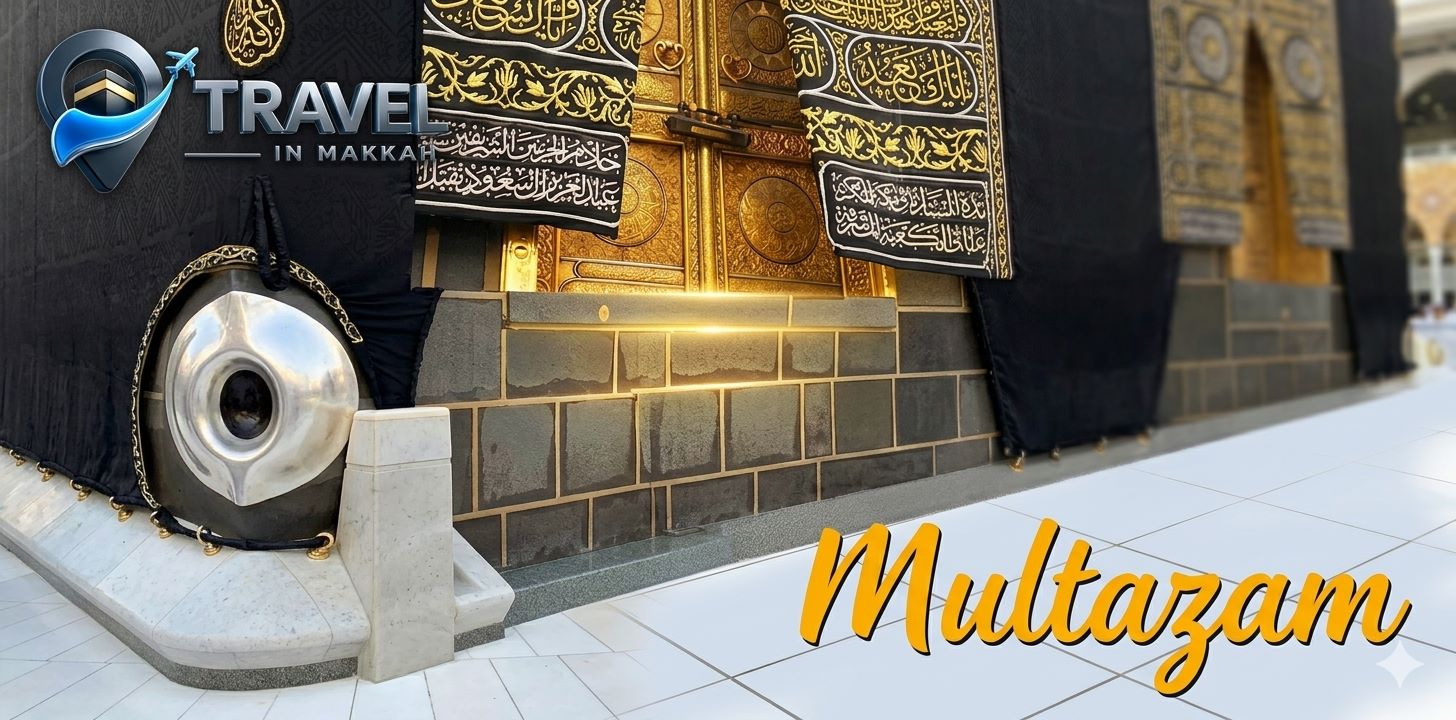
Multazam: The Sacred Place Between the Black Stone and the Door of the Kaaba
The Multazam (Arabic: الملتزم) is one of the most sacred locations in Masjid al-Haram, Makkah, located on the wall of the Holy Kaaba. It refers to the section of the Kaaba’s wall between Hajar al-Aswad (the Black Stone) and the door of the Kaaba, approximately two meters wide.
The word Multazam comes from the Arabic verb “iltizam”, which means to cling, hold firmly, or attach oneself. This name reflects the practice of pilgrims who press their chest, face, and hands against this part of the Kaaba while making supplications to Allah.
Table of Contents
- Multazam: The Sacred Place Between the Black Stone and the Door of the Kaaba
- Exact Location of the Multazam
- Evidence from Hadith and Early Islamic ReportsHadith of ʿAbd al-Rahman ibn Safwan
- Companion Narrations About the Multazam
- Ibn Abbas (رضي الله عنهما)
- Mujahid (Tabi'i Scholar)
- Opinions of Classical ScholarsImam al-Nawawi
- Ibn Taymiyyah
- Ibn Kathir
- How to Make Du'a at the Multazam (Sunnah Practice)
- Is Supplication at Multazam Obligatory?
- Virtues of the Multazam
- Conclusion
Exact Location of the Multazam
The most widely accepted definition comes from the Companion Abdullah ibn Abbas (رضي الله عنهما) who said:
“Al-Multazam is that which lies between the Corner (Hajar al-Aswad) and the Door.”
This definition is recorded in early Islamic historical works including:
- Akhbar Makkah – al-Fakihi (d. 272 AH)
- Akhbar Makkah – al-Azraqi (d. 250 AH)
Both classical sources describe the Multazam as the section of the eastern wall of the Kaaba between the Black Stone and the Kaaba door.
Evidence from Hadith and Early Islamic Reports
Although there is no explicit hadith in Sahih al-Bukhari or Sahih Muslim that directly names “Multazam,” several narrations describe the Prophet ﷺ and his companions clinging to the Kaaba and supplicating near this area.
Hadith of ʿAbd al-Rahman ibn Safwan
ʿAbd al-Rahman ibn Safwan (رضي الله عنه) reported that during the conquest of Makkah, he saw the Prophet ﷺ at the Kaaba:
- Standing near its door
- Holding the ring of the Kaaba door
- Praising Allah and making supplication
This narration is reported in several hadith collections:
- Sunan Abu Dawud – Kitab al-Manasik (Hadith ~1890)
- Sunan Ibn Majah – Kitab al-Manasik (Hadith 2955)
- Musnad Ahmad – Hadith 25003
Many scholars consider this narration as one of the evidences for clinging to the Kaaba and making du'a near the Multazam.
Companion Narrations About the Multazam
Much of the detailed information about Multazam comes from Companion statements (athar).
Ibn Abbas (رضي الله عنهما)
Ibn Abbas reported that:
“Whoever supplicates between the Black Stone and the door of the Ka’bah will see signs of acceptance.”
This narration is recorded in:
- Akhbar Makkah – al-Fakihi
- Akhbar Makkah – al-Azraqi
Although this statement is mawquf (from a Companion) rather than a direct prophetic hadith, many scholars consider it strong evidence for the virtue of the Multazam.
Mujahid (Tabi'i Scholar)
The famous Tabi'i scholar Mujahid ibn Jabr (d. 104 AH) said:
“The area between the Black Stone and the door is called the Multazam. Allah grants what is asked there and protects from what is sought refuge there.”
This statement is also reported in Akhbar Makkah by al-Fakihi.
Opinions of Classical Scholars
Many classical scholars discussed the Multazam and its virtues.
Imam al-Nawawi (d. 676 AH)
In Al-Majmu' Sharh al-Muhadhdhab, Imam Nawawi stated that:
It is recommended (mustahabb) for a pilgrim to cling to the place between the Black Stone and the Kaaba door and make du'a there.
Ibn Taymiyyah (d. 728 AH)
In Majmu' al-Fatawa, Ibn Taymiyyah explained that:
Some narrations about the Multazam contain weakness. However, the practice of the early Muslims (Salaf) confirms the legitimacy of making du'a there. He allowed the practice but warned against crowding, exaggeration, or treating it as an obligatory ritual.
Ibn Kathir (d. 774 AH)
In Al-Bidayah wa al-Nihayah, Ibn Kathir mentions the Multazam while describing the parts of the Kaaba and quotes early reports from Ibn Abbas and other scholars.
How to Make Du'a at the Multazam (Sunnah Practice)
When possible, pilgrims may perform iltizam at the Multazam. The traditional method described by scholars includes:
- Stand between Hajar al-Aswad and the Kaaba door.
- Press your chest against the Kaaba wall.
- Place your cheeks and hands on the wall.
- Raise your hands and make sincere du'a to Allah.
This action symbolizes humility, dependence, and deep devotion. However, scholars emphasize that if the area is crowded, pilgrims should avoid pushing or harming others and may supplicate from a distance.
Is Supplication at Multazam Obligatory?
No. The majority of scholars agree that supplication at the Multazam is recommended (mustahabb) but not obligatory. Therefore:
- Missing it does not affect the validity of Hajj or Umrah.
- Pilgrims may make du'a anywhere in Masjid al-Haram.
Virtues of the Multazam
Early Islamic scholars and reports highlight several virtues of this sacred place. Some early reports indicate that:
- Du'a made there has strong hope of acceptance.
- It was a place where the Companions and early Muslims supplicated intensely.
However, scholars clarify that acceptance of du'a ultimately depends on Allah’s will, and the Multazam should not be treated as a guaranteed place of answered prayers.
Conclusion
The Multazam is one of the most spiritually significant locations around the Kaaba in Masjid al-Haram. Defined as the area between Hajar al-Aswad and the Kaaba door, it has been recognized since the earliest generations of Islam as a place where believers cling to the Kaaba and make heartfelt supplications.
Although the specific hadith about Multazam vary in strength, the practice of the Companions and early scholars firmly established it as a recommended place for du'a.
Pilgrims visiting Makkah may take this opportunity—if accessible—to humble themselves before Allah at this sacred spot and ask for His mercy, forgiveness, and blessings.
Visit our home page
Written by
Travel in Makkah
Sharing insights about pilgrimage, spiritual journeys, and sacred travel experiences.