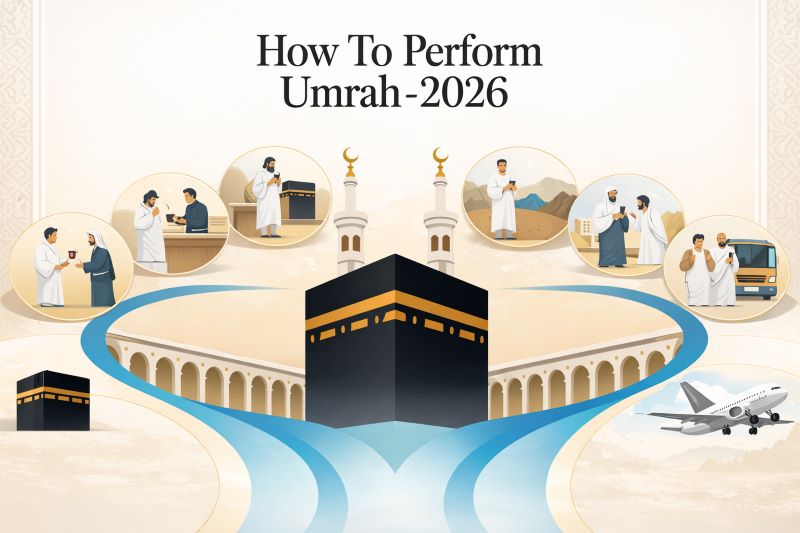
How To Perform Umrah-2026
Performing Umrah is one of the most beautiful and spiritually rewarding journeys a Muslim can experience. It is an act of worship that combines faith, humility, patience, and deep connection with Allah. Unlike Hajj, Umrah can be performed at almost any time of the year, making it accessible for millions of Muslims worldwide.
Although Umrah is not obligatory like Hajj, it holds great spiritual importance in Islam. The Prophet Muhammad (peace be upon him) encouraged Muslims to perform it and mentioned its powerful rewards, including forgiveness of sins. For many believers, Umrah becomes a life-changing moment that renews faith and strengthens the heart.
This guide explains everything in simple language so that even first-time pilgrims can understand clearly.
Table of Contents
- How To Perform Umrah – 2026
- What Is Umrah?
- Virtues and Rewards of Umrah
- Difference Between Hajj and Umrah
- Step-by-Step Guide to Perform UmrahStep 1: Entering the State of Ihram
- Ihram Rules and Prohibitions
- Step 2: Performing Tawaf
- Step 3: Drinking Zamzam Water
- Step 4: Performing Sa’i Between Safa and Marwah
- Step 5: Halq or Taqsir (Shaving or Trimming Hair)
- Common Mistakes to Avoid During UmrahForgetting Intention (Niyyah)
- Performing Sa’i Before Tawaf
- Using Perfume in Ihram
- Wrong Direction in Tawaf
- Miscounting Rounds
- Other Related Mistakes
- Tips for First-Time Pilgrims
- Safety and Etiquette in Masjid al-Haram
- Final Advice
- Conclusion
What Is Umrah?
Umrah means “a visit.” In Islamic terminology, it refers to visiting the sacred Kaaba in Makkah and performing specific rituals inside Masjid al-Haram.
The main rituals of Umrah are:
- Entering the state of Ihram
- Performing Tawaf around the Kaaba
- Performing Sa’i between Safa and Marwah
- Shaving or trimming the hair (Halq or Taqsir)
Allah says in the Qur’an:
وَأَتِمُّوا الْحَجَّ وَالْعُمْرَةَ لِلَّهِ
(Qur’an 2:196)
Meaning: “Complete the Hajj and the Umrah for Allah.”
Virtues and Rewards of Umrah
Umrah is a great act of worship that brings spiritual purification, forgiveness, and closeness to Allah. Although it is not obligatory like Hajj, its rewards are clearly mentioned in the Qur’an and authentic Hadith. For a believer, Umrah is not just a journey to Makkah—it is a journey of mercy, repentance, and renewal.
1. Umrah Is Commanded for Allah
Allah says in the Qur’an:
وَأَتِمُّوا الْحَجَّ وَالْعُمْرَةَ لِلَّهِ
(Qur’an 2:196)
Meaning: “Complete the Hajj and the Umrah for Allah.”
This verse shows that Umrah is an important act of worship and must be performed sincerely for Allah alone. The reward of Umrah depends on pure intention (Ikhlas).
2. Umrah Removes Sins
The Prophet Muhammad (peace be upon him) said:
الْعُمْرَةُ إِلَى الْعُمْرَةِ كَفَّارَةٌ لِمَا بَيْنَهُمَا
(Sahih al-Bukhari & Sahih Muslim)
Meaning: “One Umrah to another is an expiation for the sins between them.”
This authentic hadith clearly explains that performing Umrah sincerely causes Allah to forgive the minor sins committed between one Umrah and the next. It is a powerful opportunity for purification.
3. Umrah in Ramadan Has Special Reward
The Prophet (peace be upon him) said:
فَإِنَّ عُمْرَةً فِي رَمَضَانَ تَعْدِلُ حَجَّةً
(Sahih al-Bukhari, Sahih Muslim)
Meaning: “An Umrah performed in Ramadan is equal in reward to Hajj.”
Although this does not replace the obligation of Hajj, it shows the immense reward of performing Umrah in the blessed month of Ramadan. This is why many Muslims try to perform Umrah during this time.
4. Umrah Removes Poverty and Sins
The Prophet (peace be upon him) said:
تَابِعُوا بَيْنَ الْحَجِّ وَالْعُمْرَةِ فَإِنَّهُمَا يَنْفِيَانِ الْفَقْرَ وَالذُّنُوبَ
(Sunan Ibn Majah)
Meaning: “Perform Hajj and Umrah consecutively, for they remove poverty and sins.”
This hadith shows that Umrah brings both spiritual and worldly blessings. It increases barakah and removes difficulties.
5. Pilgrims Are the Guests of Allah
The Prophet (peace be upon him) said:
الْحُجَّاجُ وَالْعُمَّارُ وَفْدُ اللَّهِ
(Sunan Ibn Majah)
Meaning: “The pilgrims of Hajj and Umrah are the guests of Allah.”
Being called the guest of Allah is a great honor. It means that Allah shows special mercy and reward to those who visit His sacred house.
6. Reward for Sincere Worship
Allah says:
وَمَا أُمِرُوا إِلَّا لِيَعْبُدُوا اللَّهَ مُخْلِصِينَ لَهُ الدِّينَ
(Qur’an 98:5)
Meaning: “And they were not commanded except to worship Allah, being sincere to Him.”
This verse reminds us that the value of Umrah depends on sincerity. When performed only for Allah, it becomes a source of forgiveness and reward.
Difference Between Hajj and Umrah
Although both are sacred pilgrimages, they are different.
- Hajj is obligatory once in a lifetime for those who are able.
- Umrah is highly recommended but not obligatory.
- Hajj has fixed dates in Dhul-Hijjah.
- Umrah can be performed any time of the year.
- Hajj includes additional rituals like standing in Arafah.
Both share similar steps such as Ihram, Tawaf, and Sa’i.
Step 1: Entering the State of Ihram
The first step of Umrah is entering Ihram at the Miqat boundary.
Before entering Ihram, it is recommended to:
- Take a full bath (Ghusl)
- Trim nails
- Remove unwanted hair
- Wear clean clothing
Men wear two white unstitched cloths. Women wear modest clothing covering the body (face and hands remain uncovered).
After wearing Ihram, make the intention:
لَبَّيْكَ اللَّهُمَّ عُمْرَةً
Meaning: “Here I am, O Allah, for Umrah.”
Then begin reciting the Talbiyah:
لَبَّيْكَ اللَّهُمَّ لَبَّيْكَ، لَبَّيْكَ لَا شَرِيكَ لَكَ لَبَّيْكَ، إِنَّ الْحَمْدَ وَالنِّعْمَةَ لَكَ وَالْمُلْكَ، لَا شَرِيكَ لَكَ
This should be repeated frequently until reaching Makkah.
Ihram Rules and Prohibitions
While in Ihram, certain actions are not allowed:
- Using perfume or scented products
- Cutting hair or nails
- Marital relations
- Hunting animals
- Arguing or using bad language
- Men wearing stitched clothes
Maintaining patience and good character is very important during this sacred state.
Step 2: Performing Tawaf
After reaching Masjid al-Haram, the next step is Tawaf.
Tawaf means walking around the Kaaba seven times in an anti-clockwise direction.
It begins at the Black Stone (Hajar al-Aswad).
When facing the Black Stone, say:
بِسْمِ اللَّهِ، اللَّهُ أَكْبَرُ
If possible, kiss or touch it. If the crowd is large, simply point toward it.
During Tawaf, you may recite Qur’an and make any personal du’a. There are no fixed supplications required.
Between the Yemeni Corner and Black Stone, it is recommended to recite:
رَبَّنَا آتِنَا فِي الدُّنْيَا حَسَنَةً وَفِي الْآخِرَةِ حَسَنَةً وَقِنَا عَذَابَ النَّارِ
After completing seven rounds, pray two rak’ahs behind Maqam Ibrahim if possible.
Step 3: Drinking Zamzam Water
After Tawaf and prayer, drink Zamzam water.
The Prophet (peace be upon him) said that Zamzam is for whatever purpose it is drunk for.
Before drinking, make intention and say:
اللَّهُمَّ إِنِّي أَسْأَلُكَ عِلْمًا نَافِعًا وَرِزْقًا وَاسِعًا وَشِفَاءً مِن كُلِّ دَاءٍ
Step 4: Performing Sa’i Between Safa and Marwah
Sa’i means walking seven times between Safa and Marwah.
This ritual honors the story of Hajar (may Allah be pleased with her), who searched for water for her son Ismail.
Allah says:
إِنَّ الصَّفَا وَالْمَرْوَةَ مِن شَعَائِرِ اللَّهِ
Start at Safa. Face the Kaaba, raise your hands, and make du’a.
One walk from Safa to Marwah counts as one round. Complete seven rounds, ending at Marwah.
Between the green lights, men should walk briskly. Women walk normally.
Step 5: Halq or Taqsir (Shaving or Trimming Hair)
After completing Sa’i, the final step is removing hair.
Men may:
- Shave the entire head (Halq) – more rewarded
- Trim the hair evenly (Taqsir)
Women trim a small portion of hair (about fingertip length).
After this, the Umrah is completed, and all Ihram restrictions end.
Common Mistakes to Avoid During Umrah
Umrah is a simple and beautiful act of worship, but small mistakes can affect its validity or reduce its reward. Many first-time pilgrims make errors not out of negligence, but due to lack of knowledge or crowd pressure. Learning about these common mistakes in advance will help you perform Umrah correctly and confidently.
Below are the most important mistakes to avoid:
1. Forgetting or Incorrect Intention (Niyyah)
The intention is the foundation of every act of worship in Islam. The Prophet (peace be upon him) said:
إِنَّمَا الأَعْمَالُ بِالنِّيَّاتِ
(Sahih al-Bukhari & Sahih Muslim)
Meaning: “Actions are judged by intentions.”
Some pilgrims forget to make the intention for Umrah at the Miqat. Others make it too early or without understanding its importance. The intention does not need to be loudly spoken, but it must be present in the heart before entering Ihram.
Without proper intention, Umrah is not valid. Therefore, always remember to make a clear and sincere niyyah before starting your pilgrimage.
2. Performing Sa’i Before Tawaf
One of the most common mistakes is performing Sa’i (walking between Safa and Marwah) before completing Tawaf.
The correct sequence in Umrah is:
- Enter Ihram
- Perform Tawaf (7 rounds)
- Pray two rak’ahs
- Perform Sa’i
- Shave or trim hair
Sa’i must be performed after Tawaf. If someone performs Sa’i first by mistake, most scholars say it should be repeated in the correct order.
Following the proper sequence is essential to ensure the validity of Umrah.
3. Using Perfume After Entering Ihram
After entering the state of Ihram, using perfume or scented products becomes prohibited. This includes:
- Perfume on clothes or body
- Scented soap or shampoo
- Deodorants with fragrance
The Prophet (peace be upon him) prohibited perfume while in Ihram. Therefore, pilgrims must avoid all scented items until they complete Halq or Taqsir (shaving or trimming the hair).
Many people accidentally use perfumed soap in hotels. Always check product labels carefully before using anything during Ihram.
4. Performing Tawaf in the Wrong Direction
Tawaf must be performed in an anti-clockwise direction, with the Kaaba on the left side.
A common mistake is walking in the wrong direction or reversing the order due to crowd movement. Tawaf must start from the Black Stone (Hajar al-Aswad) and continue around the Kaaba seven times in the correct direction.
If someone walks the wrong way even briefly, that part of the circuit may not count. Always pay attention to floor markings and follow the flow of pilgrims.
5. Miscounting the Number of Rounds
Tawaf requires seven complete circuits. Sa’i also requires seven laps.
Sometimes pilgrims lose count because of distractions or crowds. This can lead to performing fewer or more rounds than required.
To avoid this mistake:
- Use a small counting device if needed
- Count clearly in your mind
- Focus only on the number of completed rounds
If you are unsure about the count, it is safer to assume the lesser number and complete the remaining rounds.
Accuracy is important to ensure the validity of both Tawaf and Sa’i.
6. Other Related Mistakes
While the above are the most common, here are a few additional errors to avoid:
- Not entering Ihram from the correct Miqat boundary
- Covering the face fully during Ihram (for women)
- Wearing stitched clothes during Ihram (for men)
- Skipping the two rak’ahs after Tawaf
- Performing Tawaf inside the Hijr area (it must be outside it)
Each step of Umrah has specific rules, so learning them beforehand is highly recommended.
Final Advice
Umrah is an act of worship that requires knowledge, patience, and sincerity. Mistakes usually happen because of confusion or crowd pressure, not intention. By understanding the common errors in advance, you can perform your Umrah smoothly and correctly.
Always remember:
- Follow the correct order of rituals
- Keep the intention clear
- Avoid prohibited actions during Ihram
- Stay calm in crowded areas
- Seek guidance if unsure
The goal of Umrah is not perfection in movement, but sincerity in heart. When performed correctly and with humility, Umrah becomes a source of forgiveness, mercy, and spiritual renewal.
Learning the steps properly prevents mistakes.
Tips for First-Time Pilgrims
- Perform rituals during less crowded times
- Stay hydrated
- Wear comfortable shoes
- Focus on worship, not photography
- Be patient in crowds
- Make sincere du’a
Remember, Umrah is about devotion, not speed.
Safety and Etiquette in Masjid al-Haram
- Avoid pushing
- Follow directions
- Keep the mosque clean
- Speak softly
- Respect other pilgrims
- Good manners reflect true Islamic character.
Conclusion
Umrah is a powerful spiritual journey that cleanses the heart and strengthens faith. From entering Ihram to completing Tawaf, Sa’i, and Halq, every step carries deep meaning.
By understanding the correct method and performing the rituals sincerely, a Muslim can experience immense peace and forgiveness.
May Allah accept every pilgrim’s Umrah and grant all Muslims the opportunity to visit His sacred house.
Ameen.
Read More: Explore everything you need for your sacred journey at Travel in Makkah. Start from our homepage to get a complete overview, then visit our Shop page to find essential travel items for Hajj and Umrah. Learn more about our mission and services on the About page, and read helpful guides and updates on our Blog to prepare yourself better. When you're ready, you can easily book your journey through our booking page and begin your spiritual experience with confidence.
Written by
Travel in Makkah
Sharing insights about pilgrimage, spiritual journeys, and sacred travel experiences.