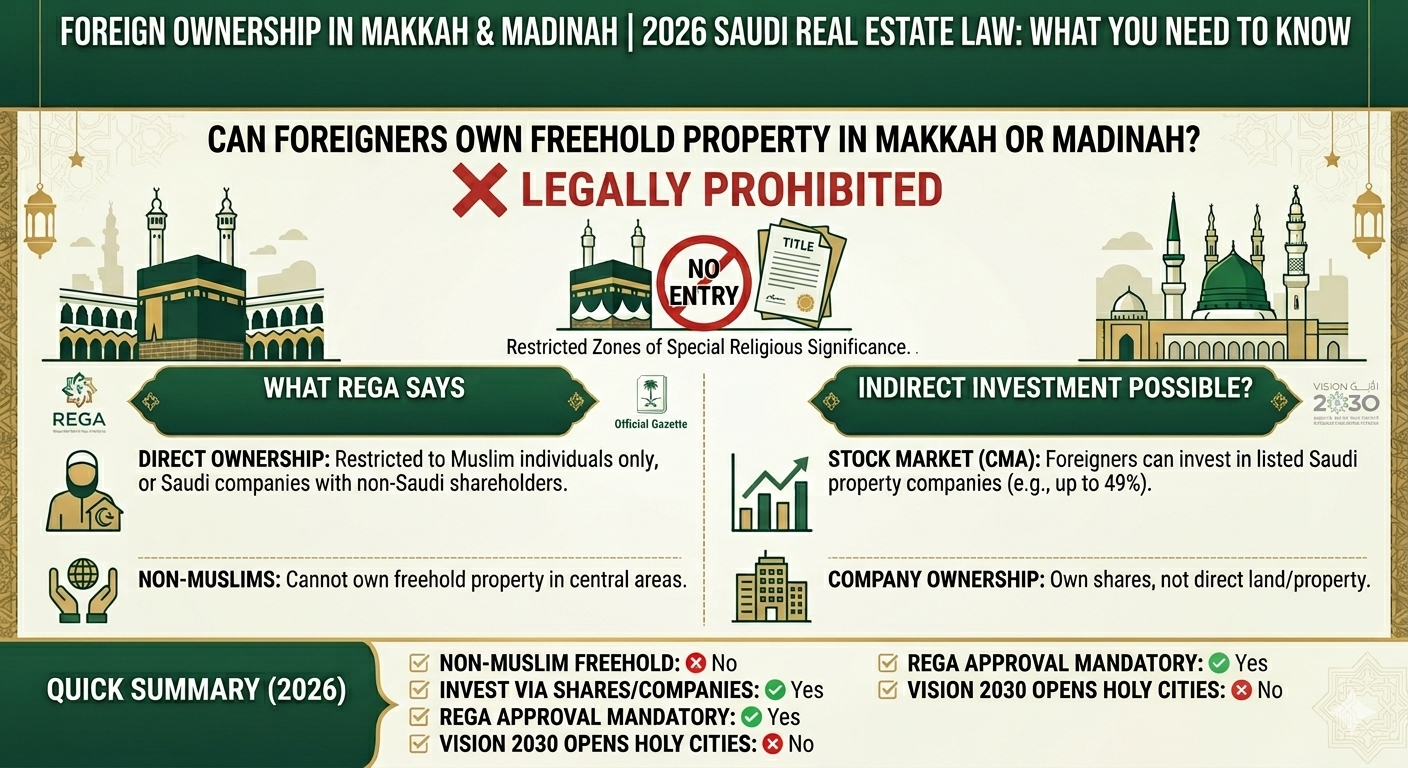
The new Saudi Real Estate Ownership Law, effective January 21, 2026, has reshaped the rules for foreigners looking to own property in Saudi Arabia. Naturally, the biggest question on everyone’s mind is:
Can foreigners now legally buy property in Makkah or Madinah?
Let’s break it down clearly, based on official and trusted sources like REGA, King & Spalding, White & Case, the Official Gazette (Umm Al-Qura), and Saudi Vision 2030.
Table of Contents
- Can Foreigners Buy Property in Makkah or Madinah? (2026 Guide)
- A Quick Background on the 2026 Law
- Can Foreigners Buy Property in Makkah or Madinah?
- What REGA Says
- Freehold Ownership for Non-Muslims
- Can You Invest Indirectly?
- Are There Any Exceptions?
- Vision 2030 and Holy Cities
- Common Myths Debunked
- How the Law Works: Zoning
- Bottom Line (2026 Position)
- Why the Restrictions Exist
- Practical Tips for Investors
- Quick Yes/No Summary
- Final Verdict
1. A Quick Background on the 2026 Law
- Council of Ministers Approval: July 14, 2025
- Official Gazette Publication: July 25, 2025
- Effective Date: January 21, 2026
White & Case described it as a “landmark law” for regulating non-Saudi property ownership.
King & Spalding explained:
“The New Law replaces previously restrictive and fragmented rules with a model governed predominantly by geographical zoning.”
Simply put, whether you can own property now depends largely on where the property is located.
2. Can Foreigners Buy Property in Makkah or Madinah?
No.
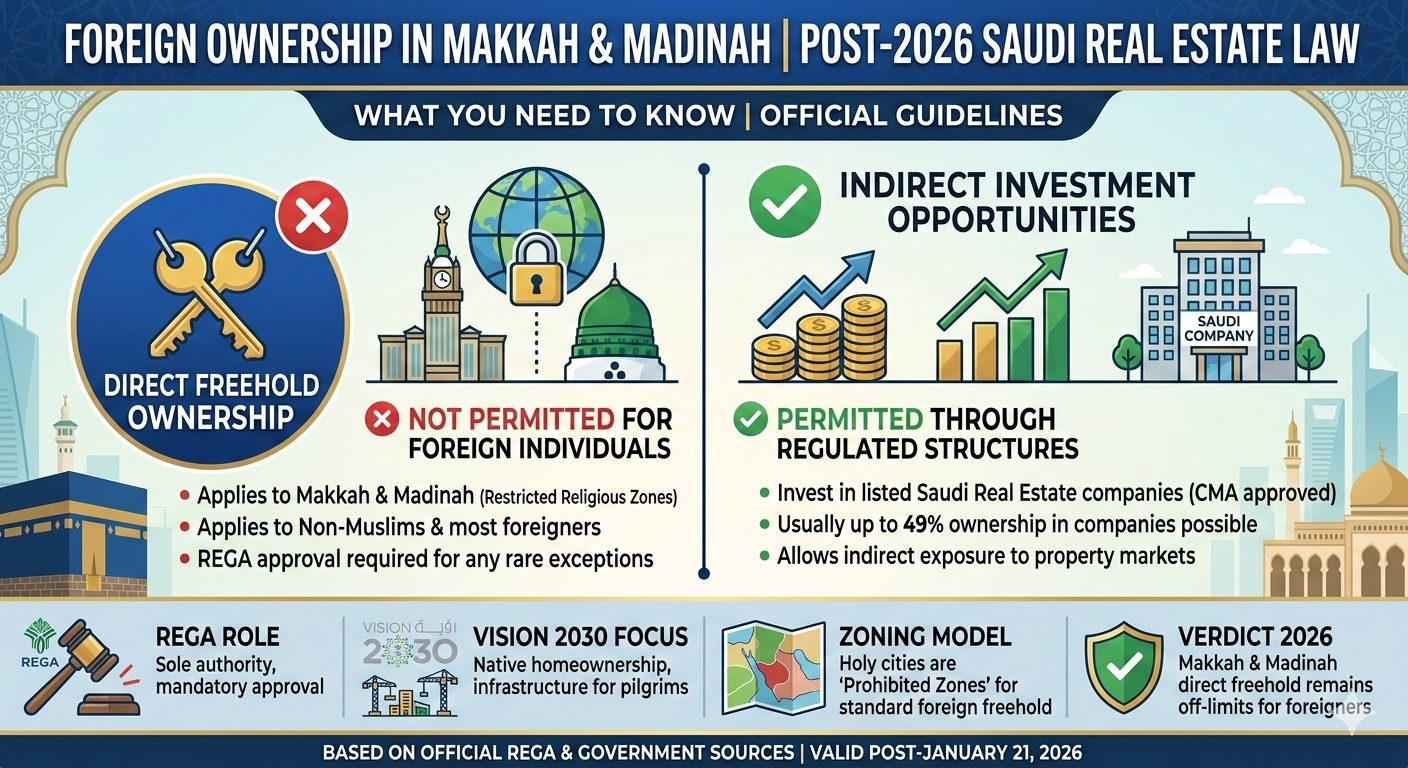
Makkah and Madinah are special religious zones, and standard foreign ownership is not permitted.
King & Spalding notes:
“Ownership in certain areas of special religious significance is restricted, and any exceptions require strict conditions and official approval.”
So, don’t believe anyone telling you otherwise—ownership rules here are strict.
3. What REGA Says
According to the Real Estate General Authority (REGA):
“Ownership in Makkah and Al-Madinah is restricted to Muslim individuals only, as well as to Saudi companies with non-Saudi shareholders.”
Key points:
- Muslim individuals may have limited ownership rights.
- Saudi companies can have foreign shareholders.
- Non-Muslims and most foreigners cannot directly own property.
REGA is the sole authority enforcing this, and without their approval, ownership is not legal.
4. Freehold Ownership for Non-Muslims?
Straight answer: ❌ No
- Non-Muslims cannot own freehold property in central Makkah or Madinah.
- REGA will not approve registrations in the Real Estate Registry for non-Muslims.
5. Can You Invest Indirectly?
Yes, but carefully.
- The Saudi Capital Market Authority (CMA) allows foreigners to invest in listed Saudi property companies.
- Usually, up to 49% ownership is permitted.
- Important: This is company ownership, not direct property ownership.
6. Exceptions?
The law allows rare exceptions, but:
- Requires Council of Ministers approval
- Requires REGA approval
- Strict conditions apply
As of now, no standard exception exists for ordinary foreign investors.
7. Vision 2030 and Holy Cities
Official Vision 2030 documents do not open Makkah or Madinah to foreign freehold ownership. The plan focuses on:
- Increasing homeownership for Saudis
- Expanding infrastructure for 30 million pilgrims
- Developing housing and facilities
Religious zoning remains intact.
8. Common Myths Debunked
❌ Myth: “Foreigners can buy apartments in central Makkah.” – False
❌ Myth: “Property ownership guarantees residency.” – False
❌ Myth: “Vision 2030 allows foreign ownership in holy cities.” – False
Always check official sources before investing.
9. How the Law Works: Zoning
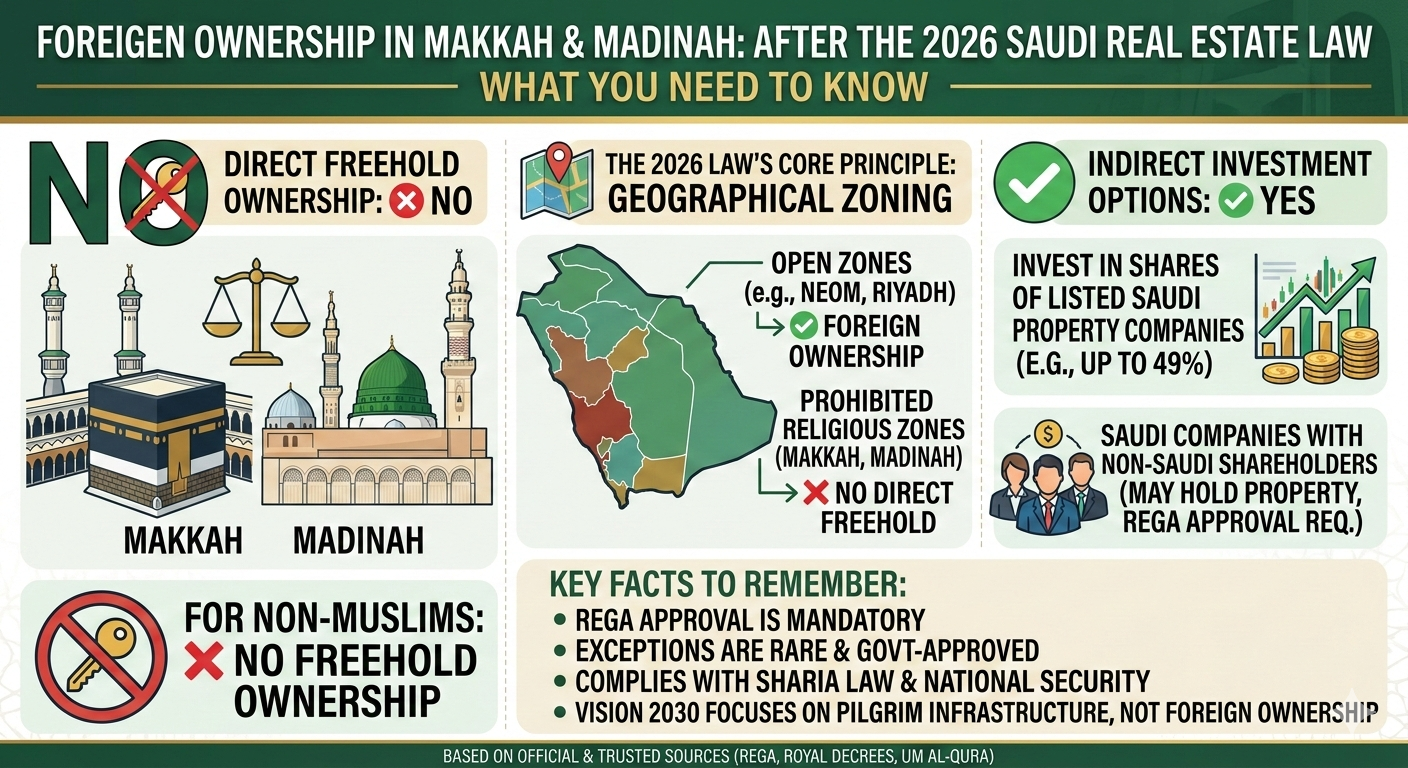
The 2026 law divides land into:
- Open Zones: Foreigners can own freely
- Restricted Zones: Limited ownership with approval
- Prohibited Religious Zones: Holy cities like Makkah & Madinah
Holy cities = Prohibited Zone for freehold ownership.
10. Bottom Line (2026 Position)
- Foreigners can own property in many parts of Saudi Arabia.
- Direct freehold in Makkah and Madinah remains off-limits.
- Investment is possible via shares, companies, or regulated structures.
- Non-Muslim foreigners cannot own property in the holy cities.
- Muslim foreigners face restrictions and REGA approval is required.
11. Why the Restrictions?
- Preserve religious sanctity
- Compliance with Sharia law
- National security & urban planning
- Manage pilgrim accommodation & flow
12. Practical Tips for Investors
- Always check REGA zoning maps
- Confirm the property’s exact location
- Understand direct vs. company ownership
- Rely on official gazettes, not marketing claims
13. Quick Yes/No Summary
QuestionAnswer (2026)
Can non-Muslims own freehold in central Makkah?
❌ No
Can foreigners buy shares in Saudi property companies?
✔ Yes
Does Vision 2030 open holy cities?
❌ No
Are exceptions possible?
✔ Rare & government-approved
Is REGA approval mandatory?
✔ Yes
Final Verdict:
As of 2026, direct foreign ownership of freehold property in Makkah and Madinah is legally prohibited. You can, however, explore investment opportunities through companies, shares, or regulated real estate structures. Be wary of any claims suggesting otherwise—they are legally unfounded.
Read More: Explore everything you need for your sacred journey at Travel in Makkah. Start from our homepage to get a complete overview, then visit our Shop page to find essential travel items for Hajj and Umrah. Learn more about our mission and services on the About page, and read helpful guides and updates on our Blog to prepare yourself better. When you're ready, you can easily book your journey through our booking page and begin your spiritual experience with confidence.
Written by
Travel in Makkah
Sharing insights about pilgrimage, spiritual journeys, and sacred travel experiences.