History of the Kiswah (Ghilaf-e-Kaaba): From Early Islam to Today
Introduction
The Kiswah, also known in many Muslim communities as Ghilaf-e-Kaaba, is the sacred cloth that covers the Holy Kaaba in Masjid al-Haram, Makkah.
In Arabic, it is called:
Arabic:
كسوة الكعبة
Meaning:
The covering of the Kaaba.
For Muslims around the world, the black cloth of the Kaaba is one of the most powerful and recognizable symbols connected to Makkah, Hajj, Umrah, and Islamic history. Every year, millions of pilgrims see the Kaaba covered with its majestic black Kiswah, decorated with Qur’anic verses in gold and silver embroidery.
But the Kiswah is more than a beautiful cloth. It represents honor, care, service, Islamic craftsmanship, and the deep respect Muslims have for the House of Allah.
This article explains the History of the Kiswah (Ghilaf-e-Kaaba): from early Islam to today in a simple, informative, and easy-to-read way.
What Is the Kiswah?
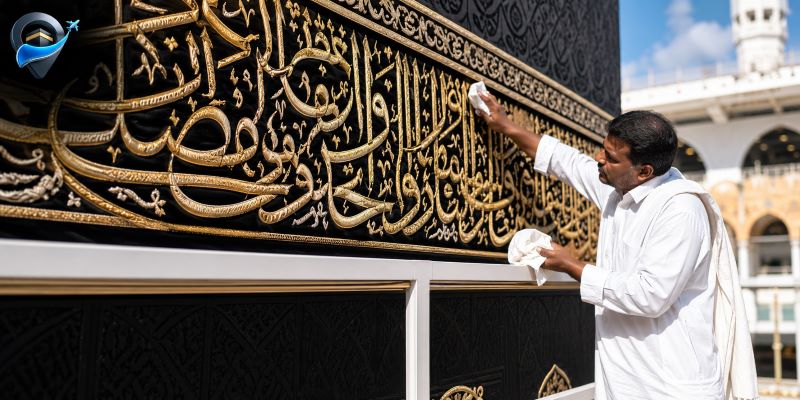
The Kiswah is the cloth that covers the Holy Kaaba. Today, it is made from black silk and decorated with Qur’anic verses and Islamic calligraphy embroidered with gold and silver-plated threads.
The Kaaba is known in Arabic as:
Arabic:
الكعبة المشرفة
Meaning:
The Honored Kaaba.
According to Saudipedia, the Kiswah is woven annually using silk, gold, and silver threads, and it covers Al-Kaaba Al-Musharrafa in Masjid al-Haram.
The Kiswah includes different parts, such as the main black covering, the embroidered belt around the Kaaba, and the curtain over the door of the Kaaba.
The door curtain is called:
Arabic:
ستارة باب الكعبة
Meaning:
The curtain of the door of the Kaaba.
The belt around the Kiswah is called:
Arabic:
حزام الكعبة
Meaning:
The belt of the Kaaba.
Why Is the Kaaba Covered?
Covering the Kaaba is an act of honor and respect for the Sacred House. Muslims do not worship the Kiswah, and they do not worship the Kaaba itself. Muslims worship Allah alone.
The Kaaba is the Qiblah, the direction Muslims face in prayer.
Arabic:
القبلة
Meaning:
The direction of prayer.
The Kiswah gives the Kaaba its dignified appearance and reflects the honor given to the House of Allah. Throughout Islamic history, Muslim rulers, caliphs, and communities considered it a great honor to serve the Kaaba by preparing its covering.
The Kiswah is therefore a symbol of care, devotion, craftsmanship, and service to the Two Holy Mosques.
The Kiswah Before Islam
The practice of covering the Kaaba existed before Islam. Historical reports mention that Tubba Al-Himyari, a king of Yemen, was among the earliest rulers said to have covered the Kaaba before Islam. Saudipedia records this pre-Islamic connection in its history of the Kaaba’s Kiswah.
Before Islam, the Kaaba was covered with different types of cloth depending on what was available. Historical discussions mention Yemeni cloth, leather, Egyptian fabrics, and other materials used at different times.
This shows that even before Islam, the Kaaba held a special place in the hearts of people in Arabia. However, Islam later purified the Kaaba from idols and restored it as the House of Tawheed.
Arabic:
التوحيد
Meaning:
The oneness of Allah.
The Kiswah in the Time of Prophet Muhammad ﷺ
After the conquest of Makkah, the Kaaba became fully purified from idols and false worship. It returned to its true purpose as the sacred House built for the worship of Allah alone.
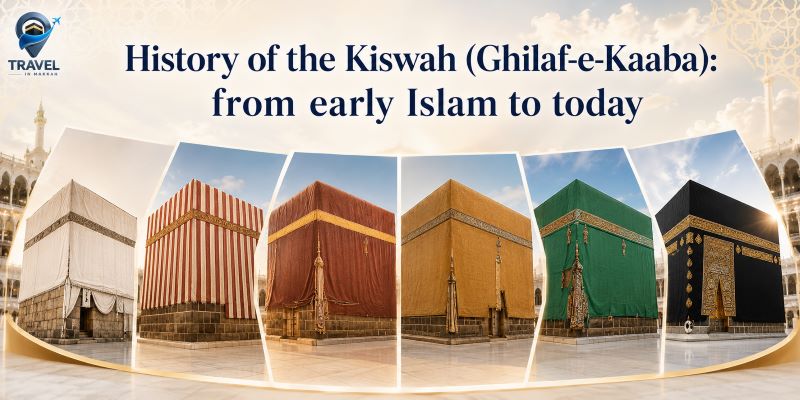
Reports mention that Prophet Muhammad ﷺ covered the Kaaba with Yemeni cloth. Saudipedia states that after the conquest of Makkah, the Prophet ﷺ draped the Kaaba with Yemeni cloth striped in white and red.
Arabic:
النبي محمد ﷺ
Meaning:
Prophet Muhammad, peace and blessings be upon him.
This period is extremely important because the honor of the Kaaba continued in Islam, but with the correct belief: the Kaaba is honored, but worship belongs only to Allah.
The Kiswah During the Early Islamic Period
After the time of the Prophet ﷺ, the Muslim caliphs continued the tradition of covering the Kaaba. The Kiswah was changed whenever needed, and the materials, colors, and methods developed over time.
During the early Islamic period, covering the Kaaba became part of the responsibility of the Muslim leadership. It showed service to the Sacred Mosque and respect for the central symbol of Muslim unity.
During the Umayyad period, the Kaaba was covered more than once a year. Saudipedia mentions that in the Umayyad era, the Kaaba was covered with two Kiswahs per year: one on the day of Ashura and another at the end of Ramadan in preparation for Eid al-Fitr.
Arabic:
عاشوراء
Meaning:
Ashura, the 10th day of Muharram.
Arabic:
عيد الفطر
Meaning:
Eid al-Fitr.
This shows how much importance Muslim rulers gave to maintaining and honoring the appearance of the Kaaba.
The Abbasid Era and the Development of Inscriptions
The Abbasid era played a major role in the development of the Kiswah. During this period, textile production, dyeing, embroidery, and Islamic calligraphy became more advanced.
One of the important developments during the Abbasid period was the use of inscriptions on the Kiswah. Saudipedia notes that the tradition of writing on the Kiswah began at the start of the Abbasid era, when caliphs wrote their names, the place of production, and the date of manufacture on the Kiswah.
During the reign of Caliph Al-Ma’mun, the Kaaba was reportedly covered three times a year.
This period helped transform the Kiswah from a simple covering into a major work of Islamic art, calligraphy, and craftsmanship.
Was the Kiswah Always Black?
No, the Kiswah was not always black.
Throughout history, the Kaaba was covered with different colors and fabrics. Historical reports mention white, red, black, and other coverings at different times.
The black Kiswah later became the established tradition. Arab News explains that the color and materials changed across history, and black eventually became preferred because it was more durable and suitable for handling during large pilgrim gatherings.
Today, the black Kiswah with gold and silver embroidery has become one of the most recognizable images of Islam.
The Kiswah and Egypt’s Historical Role
For many centuries, Egypt played an important role in producing and sending the Kiswah to Makkah. Egyptian workshops were known for textile production, and the sending of the Kiswah became a major annual event.
The Kiswah would be prepared and sent with great honor. This tradition reflected the connection between Muslim lands and the service of the Kaaba.
Before the Saudi era of local Kiswah production in Makkah, Egypt remained one of the most important centers connected to the preparation of the Kaaba’s covering.
Arab News notes that before the Saudi era developed production in Makkah, Egypt had a long historical role in sending the Kiswah.
The Kiswah in the Saudi Era
The modern Saudi era brought major changes to the production of the Kiswah.
In 1927, King Abdulaziz ordered the establishment of a dedicated facility in Makkah to produce the Kiswah. Saudipedia describes this as the first Saudi-made Kiswah produced in Makkah.
The official name of the modern complex is:
Arabic:
مجمع الملك عبدالعزيز لكسوة الكعبة المشرفة
Meaning:
King Abdulaziz Complex for the Holy Kaaba Kiswah.
Saudipedia’s timeline records that the first Saudi Kiswah workshop began in Makkah, later moved through different stages of development, and that the new Umm Al-Joud factory was inaugurated in 1977 with fully integrated production departments.
In 2017, King Salman ordered the factory to be renamed the King Abdulaziz Complex for the Holy Kaaba Kiswah.
Today, this complex is responsible for producing the Kiswah with a combination of advanced technology and skilled human craftsmanship.
How the Kiswah Is Made Today
The modern Kiswah is made through a careful and detailed process. It is not a simple cloth that is stitched quickly. It requires planning, weaving, dyeing, printing, embroidery, sewing, and quality control.
Saudipedia explains that the modern Kiswah production process includes dyeing, laboratory testing, printing, embroidery, sewing, and final care. It also mentions that hundreds of skilled artisans and technicians work in the production process.
The process generally includes:
Silk preparation
Dyeing the silk black
Weaving the fabric
Printing calligraphy patterns
Embroidering Qur’anic verses
Using gold and silver-plated threads
Sewing the different sections
Preparing the belt and door curtain
Final inspection before installation
The work requires precision and patience because every part of the Kiswah must fit the Kaaba properly.
What Is the Kiswah Made Of?
Today, the Kiswah is made from high-quality black silk and decorated with gold and silver-plated threads.
Saudipedia states that the Kiswah weighs around 980 kg and includes black silk, gold wire, and silver wire. It also states that the annual cost in 2022 exceeded SAR 20 million.
These figures show how much care and investment go into producing the Kiswah each year.
However, the beauty of the Kiswah is not about luxury for display. It is about honoring the Sacred House with excellence, dignity, and craftsmanship.
Qur’anic Verses on the Kiswah
The Kiswah is decorated with Qur’anic verses and Islamic phrases. These are embroidered with great care and respect.
One of the phrases often associated with the Kaaba and Islamic calligraphy is:
Arabic:
لا إله إلا الله محمد رسول الله
Meaning:
There is no god worthy of worship except Allah, and Muhammad is the Messenger of Allah.
The Kiswah also contains Qur’anic verses written in beautiful Arabic calligraphy. These verses remind pilgrims that the Kaaba is connected to Tawheed, worship, revelation, and the unity of Muslims.
When Is the Kiswah Replaced Today?
Today, the Kiswah is replaced annually on the first day of Muharram, the beginning of the Islamic Hijri year. The Saudi Press Agency reported the replacement of the Kaaba’s Kiswah on Muharram 1, 1446 AH, and explained that the new Kiswah consists of four separate sides and a door curtain.
Arabic:
محرم
Meaning:
Muharram is the first month of the Islamic calendar.
This current timing began after a Saudi royal decision changed the replacement from its older Hajj-season timing to the beginning of the Hijri year.
Before this change, the Kiswah was commonly replaced on the 9th of Dhul Hijjah, the Day of Arafat.
Arabic:
ذو الحجة
Meaning:
Dhul Hijjah, the month of Hajj.
Arabic:
يوم عرفة
Meaning:
The Day of Arafat.
What Happens During the Kiswah Replacement?
The Kiswah replacement is a careful and organized process. The old Kiswah is removed, and the new Kiswah is raised and fixed around the Kaaba.
The new Kiswah includes four separate sides and the door curtain. The Saudi Press Agency describes the replacement process as involving the removal of the old Kiswah and replacing it with the new one, which includes four sides and the door curtain.
The door curtain is one of the most delicate parts because it must be installed carefully and aligned with the door of the Kaaba.
This process is carried out with deep respect and careful attention by trained specialists.
Why Is the Kiswah Raised During Hajj Season?
Before and during the Hajj season, the lower part of the Kiswah is often raised and covered with white cloth. This is sometimes called the “Ihram of the Kaaba.”
Arabic:
إحرام الكعبة
Meaning:
The Ihram of the Kaaba.
Saudipedia explains that the Kiswah is lifted during Hajj to preserve its cleanliness and safety and to prevent tampering or incorrect veneration by some pilgrims. It is then returned to its normal position after Hajj.
This practice protects the Kiswah during the most crowded time of the year, when many pilgrims gather around the Kaaba.
The Spiritual Meaning of the Kiswah
The Kiswah carries deep meaning for Muslims.
It reminds us of the honor of the Kaaba. It reminds us of the unity of the Ummah. It reminds us of the beauty of Islamic calligraphy and the care Muslims have shown for the Sacred House throughout history.
But it is very important to understand the correct belief:
Muslims do not worship the Kiswah.
Muslims do not worship the Kaaba.
Muslims worship Allah alone.
The Kiswah is honored because it covers the House of Allah. The Kaaba is honored because Allah made it the Qiblah and a sacred place of worship.
The real purpose is always Tawheed, obedience, prayer, and devotion to Allah.
Common Misunderstandings About the Kiswah
Is the Kiswah worshiped?
No. The Kiswah is respected, not worshiped. Worship belongs only to Allah.
Was the Kiswah always black?
No. The Kiswah had different colors in history, including white and red. Black later became the established color.
Is the Kiswah changed every year?
Yes. The Kiswah is replaced annually, and the modern replacement takes place on the first day of Muharram.
Is the Kiswah handmade?
The modern Kiswah uses both advanced machines and skilled handwork. Embroidery, sewing, quality control, and finishing require trained experts.
Can people touch or cut pieces from the Kiswah?
Pilgrims should not pull, cut, damage, or misuse the Kiswah. The raising of the Kiswah during Hajj helps protect it from damage and incorrect practices.
Timeline of the Kiswah: From Early History to Today
Before Islam
The Kaaba was covered before Islam. Historical reports mention Tubba Al-Himyari of Yemen as one of the early figures connected to covering the Kaaba.
Time of Prophet Muhammad ﷺ
After the conquest of Makkah, the Prophet Muhammad ﷺ covered the Kaaba with Yemeni cloth.
Umayyad Period
The Kaaba was covered more than once a year, including on Ashura and near the end of Ramadan.
Abbasid Period
Inscriptions began appearing on the Kiswah, and the tradition of recording names, place, and date became known.
Egyptian Contribution
Egypt played a major historical role in producing and sending the Kiswah to Makkah for centuries.
Saudi Era
In 1927, King Abdulaziz ordered the first Saudi Kiswah facility in Makkah.
Modern Complex
The Umm Al-Joud factory was inaugurated in 1977, and the facility was later renamed the King Abdulaziz Complex for the Holy Kaaba Kiswah.
Today
The Kiswah is produced in Makkah and replaced every year on the first day of Muharram.
FAQs About the History of the Kiswah
What does Kiswah mean?
Kiswah means covering or a garment. In this context, it means the sacred covering of the Kaaba.
Arabic:
كسوة الكعبة
Meaning:
The covering of the Kaaba.
What is Ghilaf-e-Kaaba?
Ghilaf-e-Kaaba is a common term used in Urdu, Bengali, and some South Asian communities for the covering of the Kaaba. In Arabic, it is called كسوة الكعبة.
Who first covered the Kaaba?
Historical reports mention Tubba Al-Himyari, a king of Yemen, as one of the earliest figures connected to covering the Kaaba before Islam.
Did Prophet Muhammad ﷺ cover the Kaaba?
Yes. Historical reports mention that after the conquest of Makkah, Prophet Muhammad ﷺ covered the Kaaba with Yemeni cloth.
Where is the Kiswah made today?
Today, the Kiswah is made at the King Abdulaziz Complex for the Holy Kaaba Kiswah in Makkah.
When is the Kiswah replaced?
The Kiswah is currently replaced every year on the first day of Muharram.
What is the Kiswah made of?
The modern Kiswah is made from black silk and decorated with gold and silver-plated threads.
Why is the Kiswah raised before Hajj?
The lower part of the Kiswah is raised before and during Hajj to protect it from damage, tampering, and incorrect practices during the crowded season.
Is the Kiswah part of worship?
No. The Kiswah is respected because it covers the Kaaba, but worship belongs only to Allah.
Conclusion
The History of the Kiswah (Ghilaf-e-Kaaba) is a beautiful story of faith, honor, craftsmanship, and service to the House of Allah.
From the pre-Islamic period to the time of Prophet Muhammad ﷺ, from the Umayyad and Abbasid eras to Egypt’s long historical role, and from the Saudi era to today’s King Abdulaziz Complex in Makkah, the Kiswah has remained a powerful symbol of respect for the Kaaba.
Today, the Kiswah is made with black silk, gold, and silver-plated embroidery, advanced technology, and skilled craftsmanship. It is replaced every year and treated with great care.
For Muslims, the Kiswah reminds us of Tawheed, humility, unity, and the honor of the Sacred House.
May Allah allow us to visit His House with sincerity and acceptance.
Arabic Dua:
اللَّهُمَّ ارْزُقْنَا زِيَارَةَ بَيْتِكَ الْحَرَامِ
Meaning:
O Allah, grant us the opportunity to visit Your Sacred House.
Visit our home page.
Written by
admin
Sharing insights about pilgrimage, spiritual journeys, and sacred travel experiences.