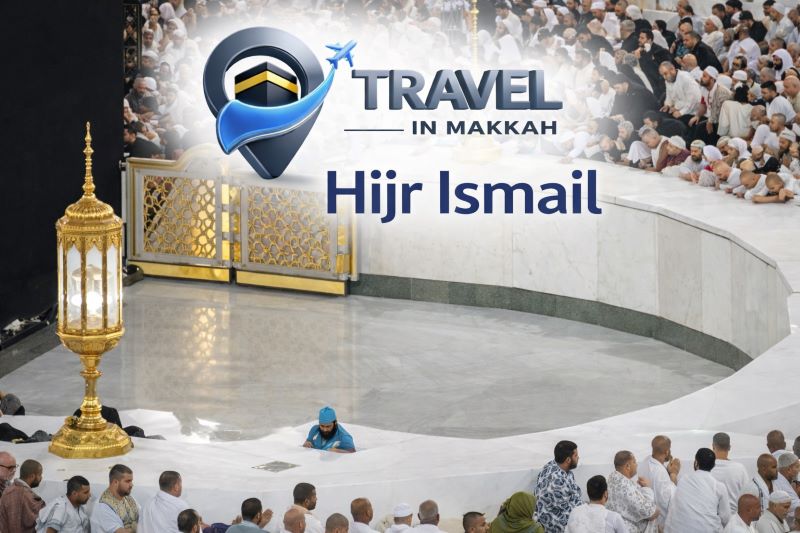
Hijr Ismail (Hatim): Complete Guide, History, Virtues & Rules (2026)
Introduction: A Sacred Space Connected to the Kaaba
Among the most spiritually powerful yet often misunderstood places in Masjid al-Haram is Hijr Ismail (حِجْر إسماعيل)—also known as Hatim. Millions of pilgrims pass by it during Tawaf, but few truly understand its deep historical significance, spiritual rewards, and authentic status in Islam.
This semi-circular area beside the Kaaba is not just an architectural feature—it is a part of the Kaaba itself. Praying here carries a unique virtue that connects directly to the legacy of Prophet Ibrahim (AS) and Prophet Ismail (AS).
In this complete 2026 guide, you will learn everything—with authentic Qur’an, Sahih Hadith, and scholarly insights—so you can fully benefit from this sacred place.
What is Hijr Ismail (Hatim)?
Hijr Ismail is a semi-circular, low white marble wall attached to the northern side of the Kaaba.
Key Facts:
- Located between Rukn al-Iraqi and Rukn al-Shami
- Positioned directly under the Mizab ar-Rahmah (Kaaba’s golden water spout)
- Approximately 1.3 meters high and 10 meters wide
- Open area, accessible to pilgrims during Tawaf
Meaning of the Name
The word “Hijr” (حِجْر) means:
- Enclosure or protected area
It is called Hijr Ismail because:
- It is historically linked to Prophet Ismail (AS)
- Some early narrations mention it as a place of residence for him and his mother Hajar (RA)
Historical Background: Was Hijr Ismail Part of the Kaaba?
The Original Kaaba
The Kaaba was originally built by:
- Prophet Ibrahim (AS)
- Prophet Ismail (AS)
Allah says in the Qur’an:
Arabic:
وَإِذْ يَرْفَعُ إِبْرَاهِيمُ الْقَوَاعِدَ مِنَ الْبَيْتِ وَإِسْمَاعِيلُ
Translation:
“And [mention] when Ibrahim was raising the foundations of the House, and [with him] Ismail…”
(Surah Al-Baqarah 2:127)
This confirms that the Kaaba’s foundation included the area now known as Hijr Ismail.
Quraysh Reconstruction (Before Islam)
When the Quraysh rebuilt the Kaaba:
- They used only pure (halal) wealth
- Due to shortage of funds, they reduced the size
- They left out a portion of the original foundation
That excluded portion became Hijr Ismail
Authentic Hadith Proof (Dalil)
The strongest evidence comes from Sahih al-Bukhari
Hadith of Aisha (RA)
Arabic:
لَوْلَا أَنَّ قَوْمَكِ حَدِيثُو عَهْدٍ بِجَاهِلِيَّةٍ لَهَدَمْتُ الْكَعْبَةَ وَلَجَعَلْتُ لَهَا بَابَيْنِ وَلَأَدْخَلْتُ فِيهَا مِنَ الْحِجْرِ
Translation:
“O Aisha! If your people were not recently out of the period of ignorance, I would have demolished the Kaaba and included in it the portion that was left out (Hijr).”
(Sahih al-Bukhari 1586)
Powerful Insight
This Hadith clearly proves:
✔ Hijr Ismail is originally part of the Kaaba
✔ It was excluded only due to construction limitations
✔ The Prophet ﷺ intended to restore it to its original form
Another Hadith
The Prophet ﷺ said:
“Pray in Hijr, for it is part of the Kaaba.”
(Reported in authentic narrations – meaning supported by scholars)
Spiritual Importance of Hijr Ismail
1. Equivalent to Praying Inside the Kaaba
One of the greatest virtues:
Praying inside Hijr Ismail = praying inside the Kaaba
This is why scholars strongly recommend offering 2 rak‘ah Nafl prayer there.
2. A Place of Accepted Du’a
Being under the Mizab ar-Rahmah (Rainwater outlet):
- Many scholars mention it as a place where du’a is accepted
- Early scholars like Ata (RA) said:
Supplication here is like being purified from sins
3. Connection to Prophetic Legacy
Standing in Hijr Ismail connects you to:
- The original structure of the Kaaba
- The legacy of Ibrahim (AS) & Ismail (AS)
- The intention of the Prophet ﷺ
It is not just a place—it is a living history of Tawheed
Rules & Etiquette for Entering Hijr Ismail
To gain full benefit, follow these guidelines:
✔ How to Pray
- Offer 2 rak‘ah Nafl prayer
- Face the Kaaba
- Keep it short due to crowd pressure
✔ Important Ruling
- Nafl prayer → Allowed and recommended
- Fard prayer → Scholars advise praying outside
Reason:
- The Prophet ﷺ prayed voluntary prayer there
✔ Behavior Inside Hijr
- Enter calmly—no pushing
- Respect others’ space
- Avoid long stays during peak time
Best Time to Enter (2026 Practical Guide)
Due to extreme crowding in recent years:
Best Times for Men:
- Early morning (8 AM – 11 AM)
Best Times for Women:
- Night hours (8 PM – 2 AM)
Smart Tip:
- Enter during Salah time (less movement in Tawaf)
Modern-Day Situation (2026 Updates)
With millions of pilgrims, Saudi authorities have introduced advanced systems:
✔ Crowd Management
- AI-based monitoring systems
- Controlled entry points
- Flow regulation during peak Tawaf hours
✔ Facilities
- Wheelchair accessibility
- Smooth marble flooring
- Guided movement by security
✔ High-Density Periods
- Ramadan & Hajj seasons
- Area may be temporarily restricted
Always follow official instructions to avoid risk.
Common Misconceptions About Hijr Ismail
❌ Myth 1: Graves of Hajar & Ismail are confirmed here
✔ Reality:
- These are historical narrations
- No Sahih Hadith confirms this
❌ Myth 2: It is separate from the Kaaba
✔ Reality:
- It is part of the original Kaaba
❌ Myth 3: You must pray there for Umrah validity
✔ Reality:
- It is not obligatory
- Only a recommended Sunnah act
Why Hijr Ismail Matters for Every Pilgrim
Understanding Hijr Ismail changes your entire experience:
- You realize you are standing inside the Kaaba’s original boundary
- Your prayer becomes more meaningful
- Your connection to Islamic history deepens
Many pilgrims miss this opportunity simply due to lack of knowledge
Pro Tips for Pilgrims (SEO Value Section)
If you want to maximize your visit:
- Try entering during low crowd hours
- Keep your prayer short but focused
- Make sincere du’a under Mizab
- Avoid rushing—maintain khushu (humility)
Conclusion: A Hidden Treasure Beside the Kaaba
Hijr Ismail is one of the most spiritually valuable yet overlooked places in Makkah.
It is:
- A part of the Kaaba
- A place of powerful prayer
- A connection to Prophets Ibrahim & Ismail (AS)
The Prophet ﷺ himself confirmed its importance, yet many pilgrims pass by it without realizing its value.
If you ever get the chance, step inside, pray, and make du’a—because in that moment, you are standing within the original House of Allah.
visit our home page
Written by
Travel in Makkah
Sharing insights about pilgrimage, spiritual journeys, and sacred travel experiences.