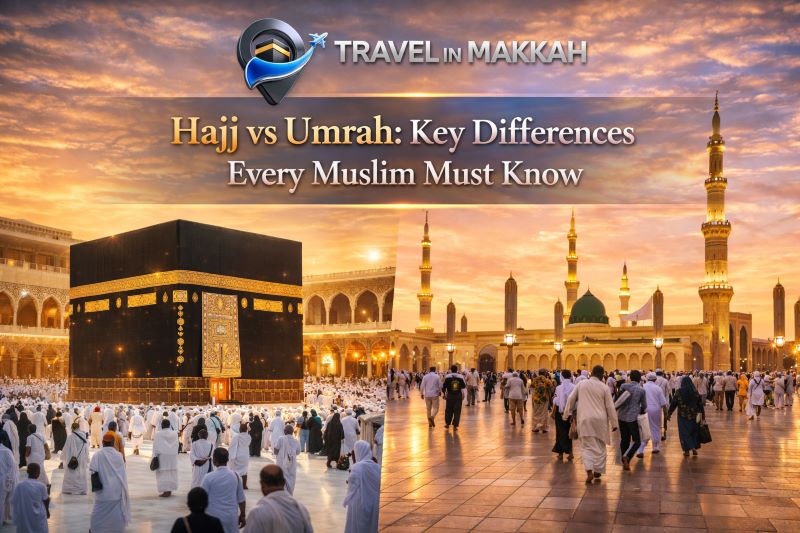
Hajj vs Umrah: Key Differences Every Muslim Must Know
Learn the key differences between Hajj and Umrah in Islam, including obligation, rituals, timing, duration, and why Umrah does not replace Hajj.
Many Muslims mention Hajj and Umrah together, but they are not the same act of worship. Both are sacred pilgrimages connected to Makkah. Both bring immense spiritual reward. Both include rituals such as Ihram, Tawaf, and Sa‘i.
However, they differ in a very important way: Hajj is a major pilgrimage with a fixed season and a wider set of rites, while Umrah is a shorter pilgrimage that can generally be performed throughout the year.
Allah says:
وَلِلَّهِ عَلَى النَّاسِ حِجُّ الْبَيْتِ مَنِ اسْتَطَاعَ إِلَيْهِ سَبِيلًا
“Pilgrimage to this House is an obligation by Allah upon whoever is able among the people.”
Source: Qur’an 3:97
This verse is the clearest proof for the legal weight of Hajj. That is why every Muslim should understand the difference between Hajj and Umrah properly. Confusing the two can lead to practical mistakes, wrong expectations, and religious misunderstanding.
Table of Contents
- What Is Hajj?
- What Is Umrah?
- The Biggest Difference: Obligation
- Timing: Fixed Season vs Flexible Timing
- Duration: Hajj Is Longer, Umrah Is Shorter
- Rituals: Shared Foundations, Different Scope
- Difficulty: Is Hajj Harder Than Umrah?
- Can Umrah Replace Hajj?
- Similarities Every Muslim Should Also Know
- A Practical Muslim’s Summary
- Final Verdict
- FAQ
What Is Hajj?
Hajj is the major pilgrimage to the Sacred House in Makkah and one of the five pillars of Islam. It is performed only during the known Hajj season in Dhul-Hijjah, and its rites extend beyond Makkah to places such as Mina, Arafat, and Muzdalifah.
The Prophet ﷺ said:
الْحَجُّ الْمَبْرُورُ لَيْسَ لَهُ جَزَاءٌ إِلَّا الْجَنَّةُ
“An accepted Hajj has no reward except Paradise.”
Source: Sahih al-Bukhari 1773 / Sahih Muslim 1349a
This hadith shows the extraordinary virtue of Hajj. It is not simply a journey. It is one of the greatest acts of worship in Islam.
What Is Umrah?
Umrah is the lesser pilgrimage. It includes visiting the Sacred House, performing Tawaf, performing Sa‘i, and completing the rites under known conditions. Unlike Hajj, Umrah is not tied to one specific season and is generally performed throughout the year.
The Prophet ﷺ said:
الْعُمْرَةُ إِلَى الْعُمْرَةِ كَفَّارَةٌ لِمَا بَيْنَهُمَا
“One Umrah to the next is an expiation for the sins between them.”
Source: Sahih al-Bukhari 1773 / Sahih Muslim 1349a
So, Umrah is not a small matter spiritually. It is deeply rewarding, purifying, and beloved. But it does not carry the same legal rank as Hajj, because Hajj is explicitly established as a pillar of Islam, while Umrah does not carry that same pillar status.
The Biggest Difference: Obligation
The most important difference every Muslim must know is this: Hajj is obligatory for the Muslim who is able, while Umrah does not hold the same legal status.
This is the first and biggest distinction. When people casually speak as if Hajj and Umrah are equal in legal weight, that is inaccurate.
This is also why Umrah can never replace Hajj. A Muslim may perform many Umrahs, but if he or she is able and has not yet fulfilled Hajj, the Hajj obligation still remains.
Timing: Fixed Season vs Flexible Timing
Hajj takes place during specific days of Dhul-Hijjah. Its major rites are tied to a fixed annual season. If a person misses that season, then Hajj cannot be performed until the next year.
Umrah, by contrast, is generally more flexible and may be performed throughout the year, subject to current official Saudi rules and operational arrangements.
This timing difference matters in real life. Hajj requires a much more fixed and careful plan, while Umrah is usually easier to schedule around work, family, and travel needs.
Duration: Hajj Is Longer, Umrah Is Shorter
Another major difference is time.
Umrah is the shorter pilgrimage. Its rituals are often completed in a matter of hours, although travel, crowd levels, and fatigue can make the full experience longer.
Hajj, however, unfolds over several days. Its rites involve movement between multiple locations such as Mina, Arafat, and Muzdalifah. Because of that, Hajj is naturally longer, broader, and more physically demanding than Umrah.
Rituals: Shared Foundations, Different Scope
Hajj and Umrah do share some rituals. Both involve:
- entering Ihram
- performing Tawaf
- performing Sa‘i
- hair cutting or trimming in their proper context
That is why many beginners assume they are nearly the same. But the overlap should not hide the real difference.
Umrah is a shorter pilgrimage centered around the Haram with fewer rites.
Hajj includes additional rites beyond Umrah, especially:
- staying in Mina
- standing in Arafat
- spending the night in Muzdalifah
- Rami at the Jamarat
- sacrifice in certain forms of Hajj
So it is not accurate to think of Hajj as merely “a bigger Umrah.” It is better to say that Umrah is smaller in ritual scope, while Hajj is more comprehensive and season-bound.
Difficulty: Is Hajj Harder Than Umrah?
In most practical cases, yes — Hajj is harder than Umrah.
The reason is not only the number of rituals, but also:
- the fixed timing
- the larger crowds
- movement between multiple sites
- the physical strain
- the need for deeper planning and stamina
Umrah can still be tiring, especially in crowded periods, but it is usually simpler in terms of ritual load and logistics. That is why many Muslims experience Umrah as spiritually intense but practically easier than Hajj.
Can Umrah Replace Hajj?
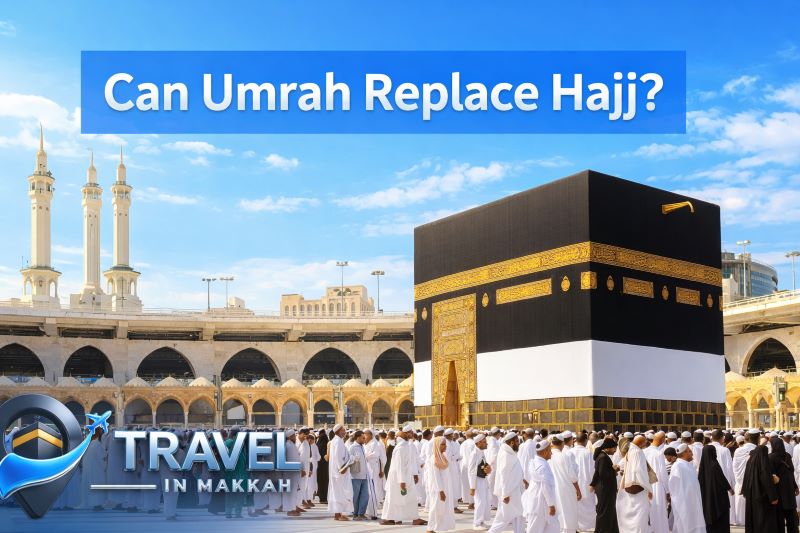
No. This is one of the most important misunderstandings to correct.
Umrah does not replace Hajj. Even though Umrah is highly rewarding, and even though it expiates sins between one Umrah and the next, it does not remove the once-in-a-lifetime Hajj duty from the Muslim who is able.
Some Muslims become confused because of the hadith about Ramadan Umrah. The Prophet ﷺ said:
عُمْرَةٌ فِي رَمَضَانَ تَعْدِلُ حَجَّةً
“Umrah in Ramadan is equal to Hajj.”
Source: Sahih al-Bukhari 1782; also narrated in Muslim
This means equality in reward, not that Ramadan Umrah legally replaces the obligation of Hajj. If it replaced Hajj, then the Qur’anic obligation of Hajj would no longer remain, and that is incorrect.
Similarities Every Muslim Should Also Know
A strong comparison should not only mention the differences. It should also explain the similarities.
Hajj and Umrah are both sacred pilgrimages connected to the Sacred House in Makkah. Both require sincerity. Both involve Ihram, Tawaf, and Sa‘i. Both are acts of worship done purely to seek Allah’s pleasure. And both can transform a believer spiritually when performed with sincerity and correctness.
At the same time, visiting Madinah is separate from the rites of both Hajj and Umrah. It is blessed and beloved, but it is not one of the core rituals of either pilgrimage.
A Practical Muslim’s Summary
If you want the easiest way to remember the difference, keep it this way:
Hajj is the major pilgrimage, a pillar of Islam, tied to specific days, longer in duration, broader in rituals, and more demanding physically and logistically.
Umrah is the lesser pilgrimage, shorter, generally more flexible in timing, and smaller in ritual scope — but still highly rewarding and spiritually powerful.
Final Verdict
So what are the key differences every Muslim must know?
Hajj and Umrah are both noble pilgrimages, but they are not interchangeable. Hajj is a major pillar for the Muslim who is able, performed only in its fixed season, and it includes major rites beyond Umrah. Umrah is shorter, usually more flexible, and deeply rewarding, but it does not replace Hajj.
Both can soften the heart, renew faith, and bring a person closer to Allah. But one should never be confused with the other.
For practical travel planning, always verify the latest requirements through official Saudi Hajj and Umrah channels, because permit pathways, package systems, and operational guidance can change over time.
FAQ
Is Hajj more obligatory than Umrah?
Yes. Hajj has a higher legal status because it is a pillar of Islam for the Muslim who is able, while Umrah does not hold that same pillar status.
Can Umrah be performed at any time of the year?
Generally, yes. Umrah is usually performed throughout the year, subject to current official Saudi rules and arrangements.
Can I do Umrah instead of Hajj if I cannot afford Hajj yet?
You may perform Umrah, but it does not replace Hajj. If you later become able, the Hajj obligation remains.
Is Madinah part of Hajj or Umrah?
Visiting Madinah is blessed and beloved, but the rites of Hajj and Umrah center on Makkah and, in the case of Hajj, the Hajj sites such as Mina, Arafat, and Muzdalifah.
Does Ramadan Umrah cancel the duty of Hajj?
No. The hadith speaks about reward, not legal replacement.
visit our home page
Written by
junaid
Sharing insights about pilgrimage, spiritual journeys, and sacred travel experiences.