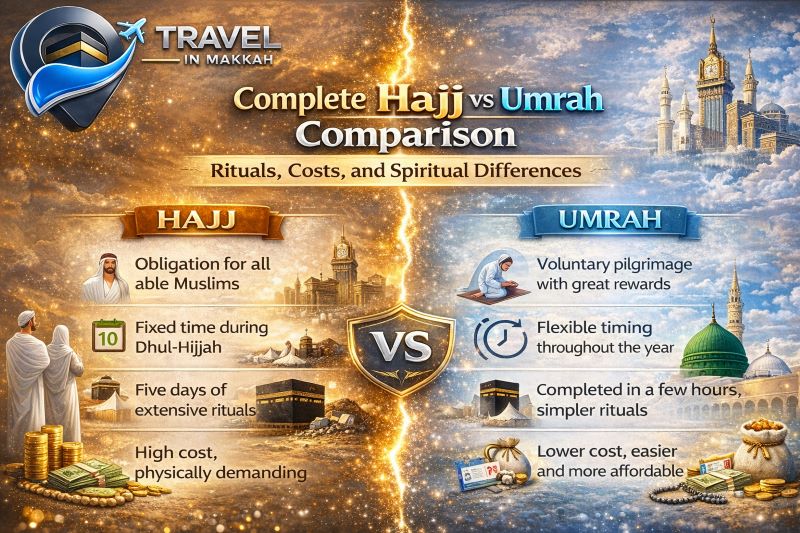
Complete Hajj vs Umrah Comparison: Rituals, Costs, and Spiritual Differences
Choosing between Hajj and Umrah is not only a matter of travel planning. For many Muslims, it is a deeply personal question connected to worship, readiness, budget, and spiritual longing.
Some people want to know which one is obligatory. Others want to understand the difference in rituals, cost, time, and physical difficulty. Many first-time pilgrims also ask an important question: Should I start with Umrah first, or should I save everything for Hajj?
The truth is that Hajj and Umrah are both sacred journeys to Makkah, but they are not the same. They differ in Islamic ruling, timing, rituals, cost, intensity, and spiritual responsibility. Hajj is one of the five pillars of Islam and becomes obligatory once in a lifetime for every Muslim who is physically and financially able. Umrah, on the other hand, is a highly rewarding pilgrimage that can be performed throughout the year and is much shorter and simpler.
This guide explains the difference in a clear, human, and beginner-friendly way. Whether you are planning your first pilgrimage, helping your family decide, or simply trying to understand the two journeys better, this article will give you a complete comparison of rituals, costs, and spiritual differences in a practical and easy-to-read format.
Table of Contents
- What Is Hajj?
- What Is Umrah?
- The Main Difference Between Hajj and Umrah
- Quick Hajj vs Umrah Comparison Table
- Shared Rituals Between Hajj and Umrah
- Rituals That Are Unique to Hajj
- Step-by-Step: How Umrah Is Performed
- Step-by-Step: How Hajj Is Performed
- Cost Difference Between Hajj and Umrah in 2025–2026
- What Makes Hajj More Expensive Than Umrah?
- Spiritual Differences Between Hajj and Umrah
- Which One Should You Choose First?
- Common Misunderstandings About Hajj and Umrah
- 2025–2026 Practical Updates for Pilgrims
- Hajj or Umrah: Which Is Better for Different Types of Pilgrims?
- Final Thoughts
What Is Hajj?

Hajj is the major pilgrimage to Makkah that takes place during specific days of Dhul-Hijjah, the last month of the Islamic calendar. It is one of the five pillars of Islam, which means it is not simply a recommended act of worship. It is a core obligation for every Muslim who is able to perform it.
Allah says:
وَلِلَّهِ عَلَى النَّاسِ حِجُّ الْبَيْتِ مَنِ اسْتَطَاعَ إِلَيْهِ سَبِيلًا
Translation:
“And [due] to Allah from the people is a pilgrimage to the House—for whoever is able to find a way to it.”
This shows that Hajj is not optional for the one who has the means. If a person is physically capable, financially able, and has a safe route and valid access, then Hajj becomes a duty.
Hajj is not completed in a few hours. It includes a series of major rituals spread over several days, including Mina, Arafat, Muzdalifah, stoning the Jamarat, sacrifice, and more. Because of this, Hajj is more demanding, more expensive, and more intense than Umrah.
What Is Umrah?
Umrah is the minor pilgrimage to Makkah. It is a beautiful and highly rewarding act of worship, but it is not the same as Hajj.
Unlike Hajj, Umrah can be performed at almost any time of the year. It is shorter, simpler, and usually completed within a few hours. For many Muslims, Umrah becomes the first experience of visiting the Haram and standing before the Kaaba.
Umrah includes four main acts:
- Ihram
- Tawaf
- Sa’i
- Halq or Taqsir
Because it is shorter and more flexible, Umrah is often the easier option for first-time pilgrims, families, elderly travelers, or those with limited budgets.
It is also spiritually powerful. The Prophet ﷺ taught that Umrah carries great reward and brings forgiveness between one Umrah and the next.
The Main Difference Between Hajj and Umrah
The easiest way to understand the difference is this:
Hajj is obligatory and fixed in time. Umrah is voluntary and flexible in time.
That one sentence already explains a lot.
Hajj:
- is a pillar of Islam
- happens only in Dhul-Hijjah
- includes more rituals
- takes several days
- requires greater physical effort
- usually costs much more
Umrah:
- is highly recommended but not the same level as Hajj
- can be performed throughout the year
- includes fewer rituals
- usually takes a few hours
- is less physically difficult
- is usually much more affordable
Both journeys are sacred. Both bring a Muslim close to Allah. But they do not carry the same legal status or level of obligation.
Hajj vs Umrah at a Glance
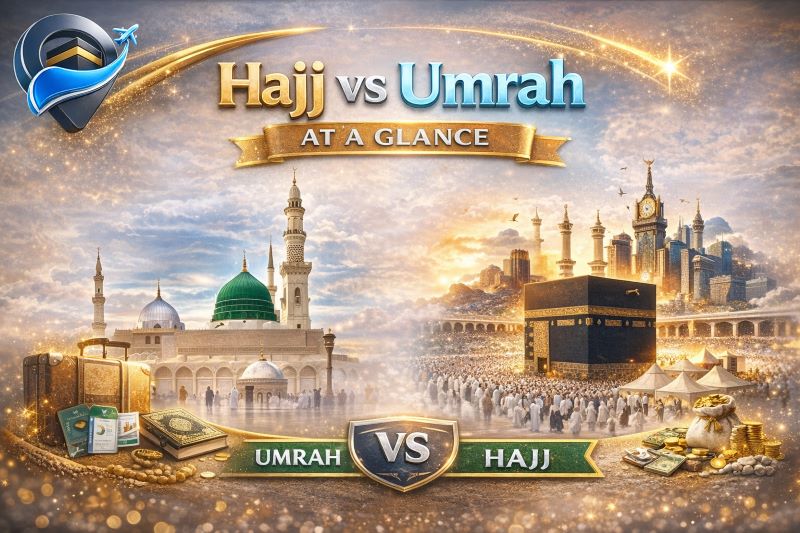
Although Hajj and Umrah are both sacred pilgrimages to Makkah, they are not the same in status, timing, difficulty, or purpose.
Hajj is a major Islamic obligation and becomes compulsory once in a lifetime for every Muslim who is physically, financially, and practically able to perform it. Umrah, however, is a voluntary pilgrimage with great reward, but it does not carry the same level of obligation as Hajj.
One of the clearest differences is timing. Hajj can only be performed during the fixed days of Dhul-Hijjah, while Umrah can be performed almost throughout the year. This makes Umrah a much more flexible option for people who want to travel based on budget, family situation, or seasonal convenience.
There is also a big difference in length and intensity. Hajj usually lasts around five to six days, and sometimes even longer depending on travel arrangements. Umrah is much shorter and can often be completed in just a few hours or within a single day.
In terms of rituals, Hajj is much more detailed. It includes major acts such as staying in Mina, standing in Arafat, spending the night in Muzdalifah, and performing Rami al-Jamarat, along with Tawaf, Sa’i, and hair cutting. Umrah is simpler and includes only Ihram, Tawaf, Sa’i, and Halq or Taqsir.
Because of these extra rites, Hajj is naturally far more physically demanding. It involves longer walking distances, intense crowds, heat, and a multi-day schedule. Umrah is generally easier to manage, although it can still feel tiring during peak times like Ramadan.
The cost difference is also significant. Hajj is usually much more expensive because it takes place in a fixed season with very high demand and requires more services, transport, and accommodation planning. Umrah is usually more affordable, which is why many first-time pilgrims and families choose it first.
From a spiritual perspective, both journeys are incredibly meaningful. But Hajj has a special position because it is one of the five pillars of Islam. Umrah also brings forgiveness, purification, and spiritual renewal, but it does not replace Hajj for a Muslim on whom Hajj has become obligatory.
In simple words, Hajj is the pilgrimage of obligation and full sacrifice, while Umrah is the pilgrimage of flexibility, ease, and repeated spiritual renewal.
For many Muslims, Umrah becomes the first step toward Hajj. But once a person is truly able, Hajj must always remain the higher priority.
Shared Rituals Between Hajj and Umrah
Even though Hajj and Umrah are different, they do share some core rituals.
1. Ihram
Both Hajj and Umrah begin with entering the sacred state of Ihram from the appropriate Miqat. This includes intention, special clothing for men, and certain restrictions.
2. Tawaf
In both journeys, the pilgrim circles the Kaaba seven times in worship.
3. Sa’i
Both include walking between Safa and Marwah seven times.
4. Halq or Taqsir
At the end, the pilgrim either shaves or trims the hair to come out of the ritual state.
These shared rituals are why many people say Umrah is a helpful preparation before Hajj. It introduces the pilgrim to the flow of worship in the Haram.
Rituals That Are Unique to Hajj
Hajj includes several major acts that do not exist in Umrah.
Mina
Pilgrims travel to Mina and spend time there during the days of Hajj.
Arafat
This is one of the greatest moments in all of Islam. Standing in Arafat is a pillar of Hajj. Without it, Hajj is not complete.
Muzdalifah
Pilgrims move from Arafat to Muzdalifah, where they spend the night and prepare for the next stage.
Rami al-Jamarat
This is the stoning of the pillars in Mina, symbolizing rejection of Shaytan.
Qurbani or Hady
In some forms of Hajj, sacrifice is required.
Tawaf al-Ifadah
This is another major Tawaf connected specifically to Hajj.
Farewell Tawaf
Before leaving Makkah, many pilgrims also perform the farewell Tawaf.
These rituals are what make Hajj longer, heavier, and far more demanding than Umrah.
Step-by-Step: How Umrah Is Performed
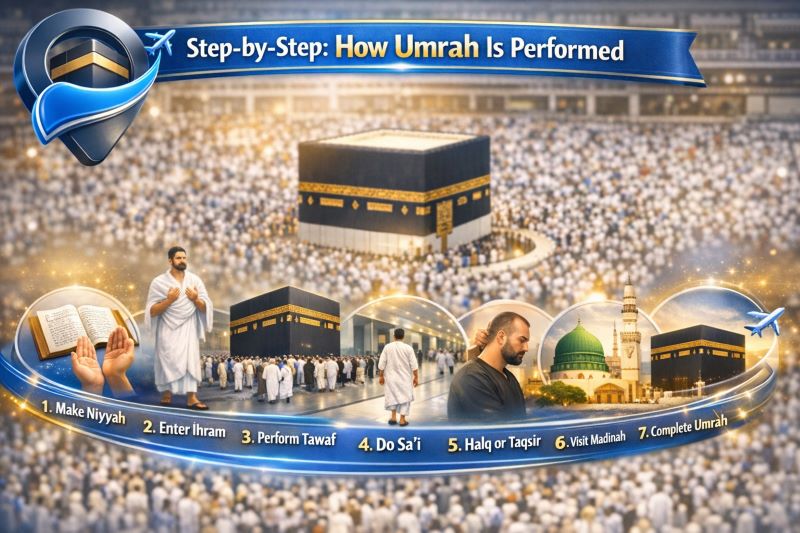
Umrah is much simpler to understand when broken down into steps.
Step 1: Enter Ihram
The pilgrim reaches the Miqat, makes intention, and enters the state of Ihram.
Step 2: Arrive at Masjid al-Haram
After entering Makkah, the pilgrim goes to the Haram and prepares for Tawaf.
Step 3: Perform Tawaf
Seven rounds are completed around the Kaaba.
Step 4: Perform Sa’i
The pilgrim walks between Safa and Marwah seven times.
Step 5: Cut or shave the hair
Men shave or trim. Women trim a small portion of hair.
At this point, Umrah is complete.
This is why many people can perform Umrah in a single day or even in a few hours, depending on crowds.
Step-by-Step: How Hajj Is Performed
Hajj is more detailed and usually follows the days of Dhul-Hijjah.
Day 1: Begin Hajj and go to Mina
Pilgrims enter Ihram for Hajj and travel to Mina.
Day 2: Arafat
This is the most important day. Pilgrims stand in Arafat making dua, repentance, and remembrance of Allah.
Night after Arafat: Muzdalifah
After sunset, pilgrims travel to Muzdalifah, pray, rest, and collect pebbles.
Day 3: Mina and major rites
Pilgrims return to Mina, stone the Jamarah, perform sacrifice where required, and shave or trim the hair. Many then perform Tawaf al-Ifadah.
Following days: Continue stoning in Mina
Pilgrims remain in Mina and continue Rami during the following days.
Final step: Farewell Tawaf
Before leaving Makkah, pilgrims perform the farewell Tawaf.
This timeline is why Hajj is not just a visit. It is a full spiritual journey with stages of hardship, patience, prayer, discipline, and surrender.
Cost Difference Between Hajj and Umrah in 2025–2026
One of the biggest practical differences between Hajj and Umrah is cost.
In general, Hajj is far more expensive than Umrah.
Based on the information you collected, Hajj packages in 2025–2026 may start around the economy range and rise sharply for premium packages. Umrah, on the other hand, remains more accessible for many Muslims.
Typical Hajj cost range
Hajj often falls into a much higher price range because it includes:
- fixed-season travel
- official package systems
- higher accommodation demand
- organized transport
- major crowd management
- meals and service arrangements
- longer stay requirements
Typical Umrah cost range
Umrah usually costs much less because:
- it is shorter
- travel dates are flexible
- off-peak travel can reduce costs
- accommodation options are wider
- some pilgrims manage parts of the journey more independently
Simple comparison
Hajj is usually a major financial project.
Umrah is usually a more manageable pilgrimage option.
That is why many Muslims do Umrah first and continue saving for Hajj.
What Makes Hajj More Expensive Than Umrah?
Many people assume the only reason is that Hajj lasts longer. But there are several reasons.
1. Hajj happens in a fixed season
Because millions of people travel in the same window, costs naturally rise.
2. Hajj requires more logistics
Transport between Mina, Arafat, Muzdalifah, and Makkah adds complexity and cost.
3. Accommodation demand is higher
Hotels and services near key locations become more expensive during Hajj.
4. Hajj packages are more structured
Pilgrims often need approved providers, official systems, and guided support.
5. More services are involved
Meals, movement, support staff, tents, group operations, and safety planning all increase the overall cost.
Umrah does not usually involve the same level of pressure or seasonal intensity unless you travel in Ramadan or another peak period.
Spiritual Differences Between Hajj and Umrah
This is where the comparison becomes more than just practical.
Hajj and Umrah are not only different in rituals. They are also different in spiritual weight.
Hajj: a pillar, a covenant, a major turning point
Hajj is one of the greatest acts of worship in Islam. It is not just a recommended spiritual trip. It is a pillar of the religion.
The Prophet ﷺ taught that an accepted Hajj carries extraordinary reward. Hajj demands sacrifice in wealth, time, energy, patience, and submission. A person leaves comfort behind and enters a journey of equality, humility, and complete surrender to Allah.
Hajj often transforms a person deeply because it combines:
- obligation
- hardship
- unity of the Ummah
- repentance
- public devotion
- remembrance of death and resurrection
Umrah: renewal, forgiveness, and closeness to Allah
Umrah is smaller in scope, but still deeply powerful. It allows the believer to stand before the Kaaba, perform sacred rituals, and seek forgiveness with ease and flexibility.
Many people describe Umrah as a journey of softness, healing, and spiritual refreshment. It may not have the same legal weight as Hajj, but it can still change a person’s heart.
If Hajj feels like a once-in-a-lifetime summit, Umrah often feels like a deeply personal return to Allah.
Which One Should You Choose First?
This depends on your situation, but the answer in Islamic principle is clear:
If Hajj is obligatory on you and you are able, Hajj should come first
Because Hajj is fard, a Muslim who is truly able should not ignore it while only focusing on repeated Umrah.
If you are not yet able for Hajj, Umrah is a beautiful starting point
For many Muslims, Umrah becomes the first practical and spiritual step. It helps them:
- learn the environment of Makkah
- understand key rituals
- grow emotionally and spiritually
- prepare themselves for future Hajj
Umrah may be better first for:
- first-time pilgrims
- families with children
- elderly travelers
- people with limited budgets
- those waiting for Hajj access or approval
- those who want experience before Hajj
So the answer is not emotional only. It is based on both Islamic duty and realistic ability.
Common Misunderstandings About Hajj and Umrah
A lot of confusion comes from hearing simplified answers. Let’s clear up the main misunderstandings.
Can Umrah replace Hajj?
No. Umrah does not replace Hajj. If Hajj becomes obligatory on a Muslim, Umrah cannot fulfill that duty.
Is Hajj valid without Umrah?
Yes. Hajj can be valid without performing Umrah in certain forms, such as Ifrad.
Is Umrah equal to Hajj?
No. Umrah is highly rewarding, but it is not equal to Hajj in obligation or ritual scope.
Can someone do many Umrahs and still owe Hajj?
Yes. A person may perform Umrah multiple times, but if Hajj is obligatory and they are able, that obligation remains.
Is one Umrah enough in a lifetime?
There is no strict rule that only one Umrah is allowed or required. A Muslim may perform Umrah many times, but repeated Umrah should never distract from an owed Hajj.
2025–2026 Practical Updates for Pilgrims
Modern pilgrimage planning is now more digital and more structured than before.
Nusuk platform
Pilgrims should expect to use official platforms such as Nusuk for booking, package review, or permit-related processes where required.
Digital planning
Pilgrimage now involves more app-based checking for:
- package verification
- registrations
- permit-linked access
- accommodation coordination
- travel arrangements
Prices can change
This is especially important. Costs are not fixed forever. Package rates, visa-related fees, hotel prices, and transport can all change with season and policy.
Health and crowd planning matter
Pilgrims should also stay updated on:
- vaccine requirements
- seasonal restrictions
- crowd-management rules
- approved providers
- official booking deadlines
For this reason, serious pilgrims should always verify the latest details before paying or finalizing travel.
Hajj or Umrah: Which Is Better for Different Types of Pilgrims?
For first-time pilgrims
Umrah is often easier as a first experience because it is shorter and less overwhelming.
For those who are fully able
Hajj must be prioritized if it has become obligatory.
For elderly pilgrims
Umrah may be more manageable due to shorter duration and lower physical burden.
For families
Umrah is often easier to organize with children and elders.
For people with limited budgets
Umrah is usually the more realistic option while continuing to save for Hajj.
For those seeking deep spiritual training before Hajj
Umrah can be a wonderful preparation ground.
Final Thoughts
Hajj and Umrah are both journeys to the same sacred House, but they are not the same journey.
Hajj is the greater obligation.
Umrah is the more flexible devotion.
Hajj carries the weight of a pillar.
Umrah carries the mercy of repeated return.
One is a once-in-a-lifetime duty for the able Muslim. The other is a precious opportunity to seek forgiveness, healing, and closeness to Allah throughout life.
If you are able for Hajj, do not delay what Allah has made obligatory.
If you are not yet able, do not underestimate the power of Umrah.
Both can transform the heart. Both can soften the soul. Both can bring you closer to Allah in ways that words often fail to describe.
The important thing is not only to compare them. The important thing is to understand them correctly, prepare sincerely, and approach them with humility.
Read More: Explore everything you need for your sacred journey at Travel in Makkah. Start from our homepage to get a complete overview, then visit our Shop page to find essential travel items for Hajj and Umrah. Learn more about our mission and services on the About page, and read helpful guides and updates on our Blog to prepare yourself better. When you're ready, you can easily book your journey through our booking page and begin your spiritual experience with confidence.
Written by
junaid
Sharing insights about pilgrimage, spiritual journeys, and sacred travel experiences.