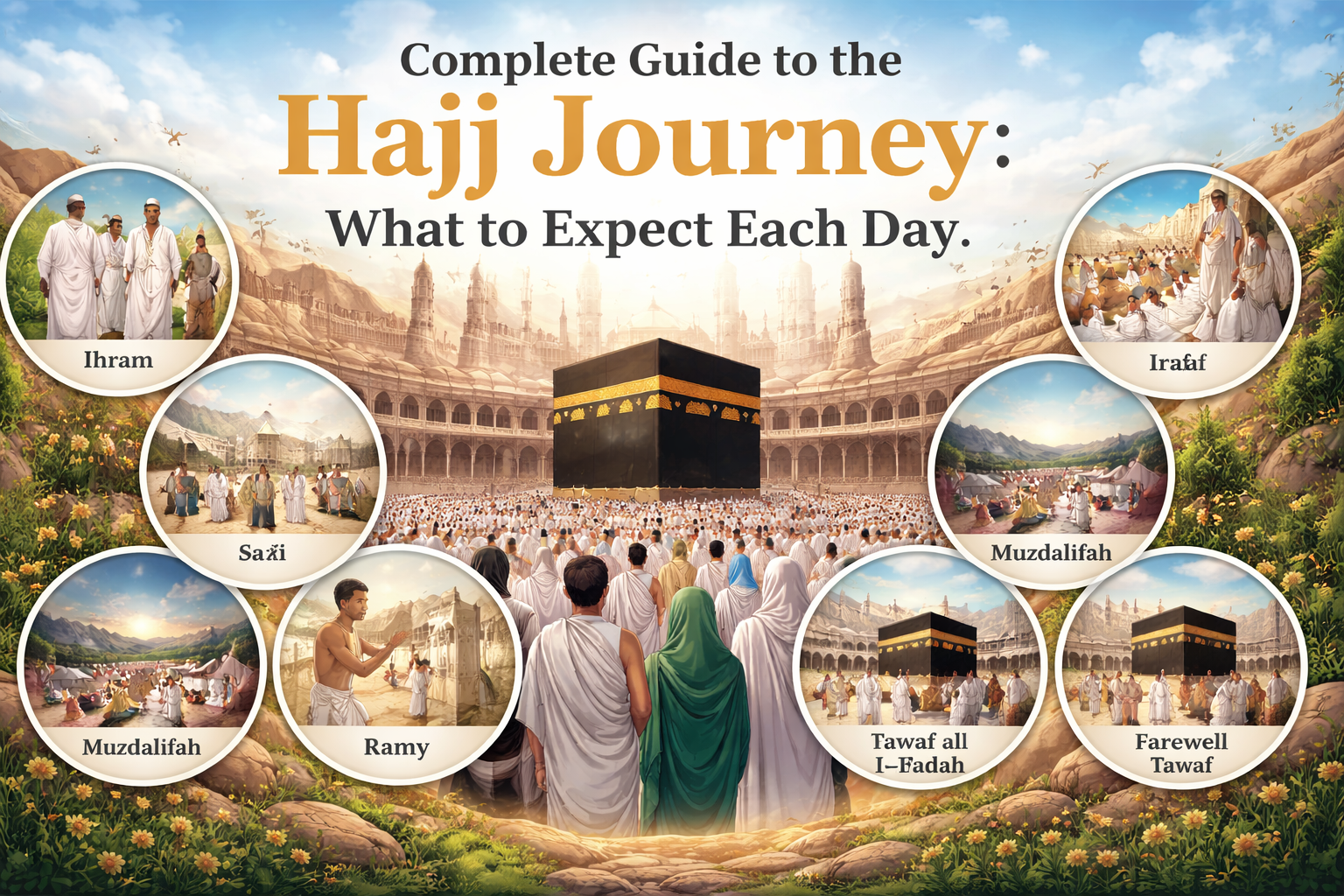
Hajj is one of the five pillars of Islam, a deeply spiritual and transformative journey that every Muslim must perform at least once in their lifetime, provided they are able. It is a significant event that allows Muslims to seek forgiveness, make supplications, and get closer to Allah. The pilgrimage involves several rituals, each of which has its own spiritual significance and importance.
At Travel in Makkah , we understand the profound impact of this sacred journey. This guide will take you through the Hajj journey day by day, offering practical and spiritual insights into what you can expect during each phase of your pilgrimage. Whether you’re a first-time pilgrim or returning for the second time, this guide will help you prepare and understand the journey.
Day 1: Arrival in Makkah and Ihram
Preparing for Hajj
Before the journey to Makkah, it’s important to prepare spiritually and physically for Hajj. This means ensuring you have all the necessary documents, such as your visa, and that you’ve packed the essential items. When you arrive in Makkah, the first step is to enter the state of Ihram.
Ihram: Entering the Sacred State
Ihram is a special dress and state of purity that all Hajj pilgrims must adopt before starting the pilgrimage. It’s a physical and spiritual preparation for the journey. For men, Ihram consists of two white unstitched cloths — one worn around the waist and the other draped over the shoulder. For women, the dress is more modest and includes a hijab and loose-fitting clothing.
Once in Ihram, pilgrims must maintain a state of purity and refrain from certain actions like cutting hair, trimming nails, or engaging in intimate relations.
First Steps in Makkah
Upon arrival in Makkah, you will go directly to the Masjid al-Haram to perform Tawaf al-Qudum, the welcoming Tawaf. This is the first time pilgrims circle the Kaabah, which is the most sacred site in Islam. It marks the beginning of the Hajj journey, and it is recommended to pray for blessings for the journey ahead.
Rest and Prayer
After completing Tawaf al-Qudum, pilgrims often find some time to rest and settle into their accommodations. It’s important to adapt to the local time zone and weather conditions, as the journey can be physically demanding. You should also offer Salah (prayers) at the Masjid al-Haram to begin your spiritual journey with peace and serenity.
Day 2: Tawaf al-Ifadah & Journey to Mina
Tawaf al-Ifadah: The Main Tawaf
On the second day, pilgrims perform Tawaf al-Ifadah. This is the main Tawaf of the Hajj pilgrimage and signifies the actual start of the core Hajj rituals. After Tawaf al-Qudum, this Tawaf is essential to complete your Hajj journey. While performing Tawaf, pilgrims walk seven times around the Kaabah, starting from the Black Stone.
Journey to Mina
After Tawaf al-Ifadah, pilgrims travel to Mina, a place known for its vast tents and one of the central locations for the Hajj rituals. Pilgrims stay here for several nights during the pilgrimage. It’s essential to prepare yourself for the crowded environment and the communal living conditions in Mina, where you will spend the night in shared tents.
Upon arrival at Mina, pilgrims are advised to offer the Dhuhr, Asr, Maghrib, and Isha prayers in congregation at the appointed times. Although you may feel physically drained after your travel, keeping up with your prayers is crucial for maintaining the spiritual focus.
Ramy al-Jamarat: Introduction to the Stoning Ritual
This day also marks the beginning of the Ramy al-Jamarat, the stoning of the three pillars representing Satan. The stoning ritual will take place on the following days, but pilgrims begin to gather pebbles and prepare themselves for the significant act of rejecting temptation.
Day 3: Arafah - The Day of Standing
The Significance of Arafah
Arafah is the most significant day of Hajj. It is considered the Day of Forgiveness, where Allah forgives the sins of those standing in Arafah. Pilgrims travel from Mina to Arafah, where they will spend the day in supplication and prayer. The day’s rituals are based on the teachings of Prophet Muhammad (PBUH) who described Arafah as a day when Allah showers His mercy and blessings upon His servants.
Day of Supplication
During the day in Arafah, pilgrims engage in personal supplications. It’s an opportunity for you to ask Allah for forgiveness, reflect on your past, and make sincere prayers for your future. Arafah is not only a physical journey but also a spiritual one where pilgrims deepen their connection with Allah.
Prayers at Arafah
Pilgrims combine their Dhuhr and Asr prayers at Arafah, which is an essential ritual. Standing in Arafah is a symbol of human humility, as all pilgrims stand before Allah, acknowledging their sins and seeking mercy.
Importance of Wuquf (Standing)
The act of standing in Arafah, known as Wuquf, is a unique and profound experience. Pilgrims stand in the open plains, in the scorching sun, enduring discomfort, yet it is an act of spiritual surrender. Wuquf signifies a profound moment of self-reflection, and every pilgrim is encouraged to remain focused on the significance of this ritual.
Departure from Arafah to Muzdalifah
After sunset, pilgrims leave Arafah and head towards Muzdalifah, where they spend the night under the open sky. Pilgrims pray the Maghrib and Isha prayers in Muzdalifah, which is a calm and peaceful moment before the next set of rituals.
Day 4: Stoning at Mina & Sacrifice
Ramy al-Jamarat: The Stoning Ritual
The stoning ritual at Mina begins on Day 4. Pilgrims throw pebbles at the three pillars, representing Satan. The act of stoning is symbolic of rejecting temptation and seeking refuge in Allah. Pilgrims must aim to throw seven pebbles at each pillar, starting with the smallest and moving to the largest.
Sacrifice (Qurbani)
Another important ritual on Day 4 is the sacrifice of an animal (usually a goat, sheep, cow, or camel) as a symbol of Prophet Ibrahim’s willingness to sacrifice his son in obedience to Allah. After the sacrifice, pilgrims can either shave their heads (for men) or trim their hair (for women) to signify their purity after performing the ritual.
Shaving or Trimming Hair
After the sacrifice, pilgrims must shave their heads (for men) or trim their hair (for women). This is a physical demonstration of spiritual purification and marks the completion of a major ritual. It’s important to perform this with humility, as it signifies renewal and cleansing of past sins.
Returning to Makkah
After the stoning and sacrifice rituals, pilgrims head back to Makkah for Tawaf al-Ifadah, the final Tawaf. This Tawaf signifies the completion of the core rituals of Hajj, and pilgrims are encouraged to pray and reflect on the journey thus far.
Day 5: Tawaf al-Ifadah & Eid Celebration
Tawaf al-Ifadah (Final Tawaf)
The Tawaf al-Ifadah is the final Tawaf that completes the physical aspect of Hajj. It is performed after the stoning and sacrifice rituals. Pilgrims walk around the Kaabah seven times in a counter-clockwise direction, offering prayers and supplications as they go. This Tawaf holds great significance and marks the completion of the major Hajj rites.
Eid al-Adha Celebrations
On Day 5, pilgrims celebrate Eid al-Adha, which commemorates Prophet Ibrahim’s sacrifice. Eid prayers are held at Masjid al-Haram, and pilgrims can engage in celebrations and prayers. It’s a joyous occasion, and the pilgrims take part in the festival with the local Muslim community.
Day 6-7: Additional Stoning at Mina & Tawaf al-Wada
Stoning the Jamarat
Pilgrims return to Mina for two additional days of stoning the Jamarat pillars. This ritual, which involves throwing pebbles at the pillars of Satan, takes place on the 6th and 7th days. It’s a final act of spiritual purification and rejection of temptation.
Tawaf al-Wada: Farewell Tawaf
Before leaving Makkah, pilgrims perform Tawaf al-Wada, the farewell Tawaf. It’s a moment of reflection and gratitude. Pilgrims make supplications, thanking Allah for the opportunity to perform Hajj and asking for safe travels back home.
Conclusion
The Hajj journey is a spiritually enriching and physically demanding pilgrimage. It is a time for Muslims to seek forgiveness, connect with Allah, and experience the unity of the Muslim ummah. By following the rituals of Hajj step by step, pilgrims not only fulfill one of the five pillars of Islam but also gain valuable spiritual lessons that will last a lifetime.
The journey is one of transformation, purification, and devotion. As you return home after completing Hajj, carry with you the lessons learned and the peace that comes from having completed this sacred pilgrimage.
FAQs About the Hajj Journey
- How long does it take to complete Hajj?
- Can I perform Hajj on behalf of someone else?
- What if I miss a ritual during Hajj?
- What to do if I get lost during Hajj?
Written by
Admin
Sharing insights about pilgrimage, spiritual journeys, and sacred travel experiences.