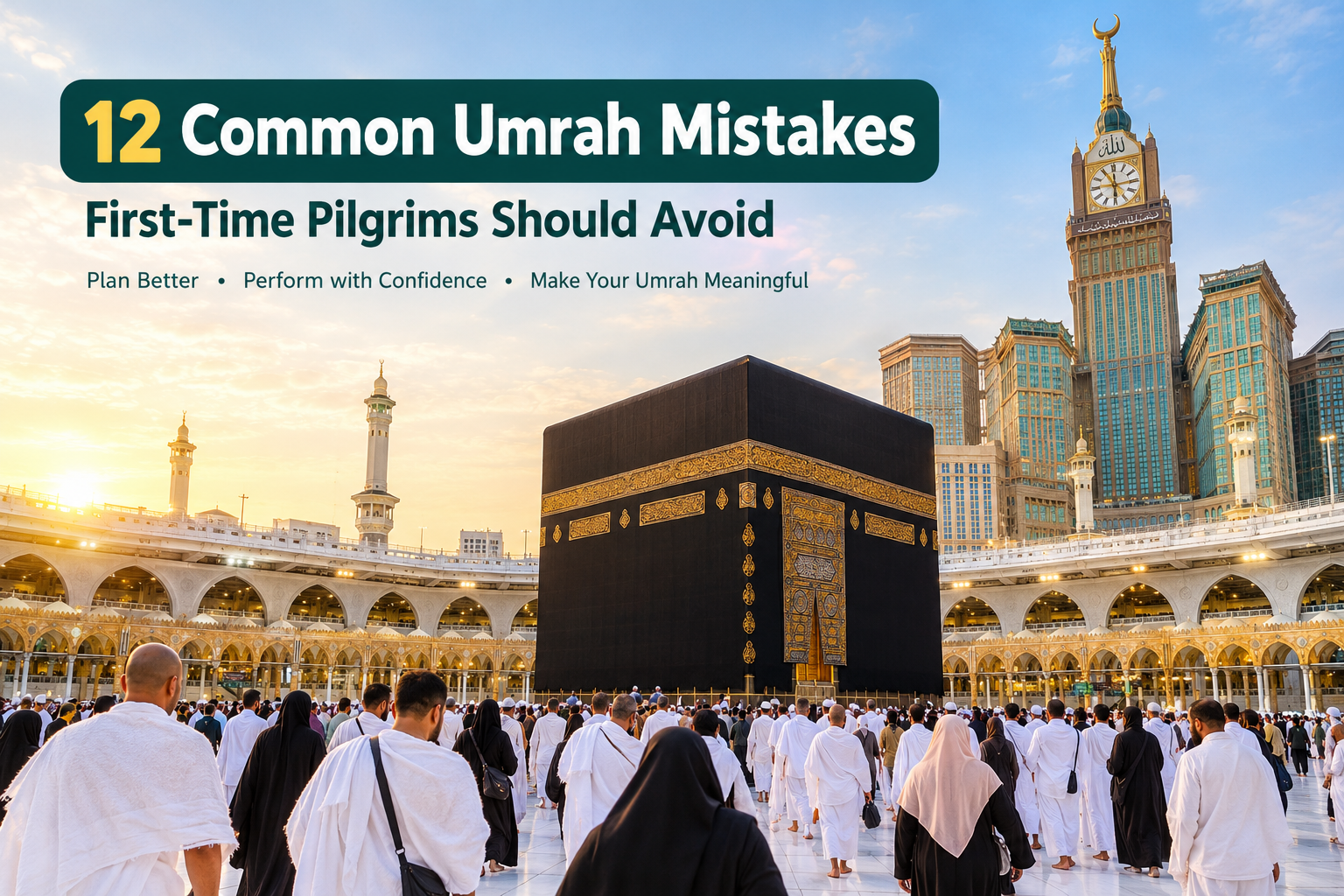
12 Common Umrah Mistakes First-Time Pilgrims Should Avoid
Performing Umrah is a deeply meaningful spiritual experience for Muslims around the world. For first-time pilgrims, however, preparing for the journey can feel overwhelming. From understanding Ihram and identifying the correct Miqat to completing Tawaf and Sa’i, there are several important details to learn before arriving in Makkah.
Many mistakes happen because pilgrims are unfamiliar with the rituals, misunderstand certain requirements, or become confused by the crowds at Masjid al-Haram.
The good news is that proper preparation can make your journey more organised, peaceful, and spiritually rewarding.
In this guide, we explain 12 common Umrah mistakes first-time pilgrims should avoid, along with practical tips to help you prepare for your pilgrimage.
Whether you are travelling alone, with family, or as part of an organised Umrah group, understanding these points can help you approach your journey with greater confidence.
Important note: This article provides general educational information about Umrah. Some religious rulings may differ according to scholarly interpretation and individual circumstances. For a specific religious question, consult a qualified Islamic scholar and check the latest official guidance from the Saudi Ministry of Hajj and Umrah.
1. Passing the Miqat Without Entering Ihram
One of the most important things to understand before travelling to Makkah is the Miqat.
A Miqat is a designated boundary associated with entering the state of Ihram for Hajj or Umrah. Pilgrims intending to perform Umrah must understand which Miqat applies to their journey and prepare accordingly.
If you are travelling by air, do not assume that you can wait until you arrive in Jeddah or Makkah to make all your preparations. Depending on your route and circumstances, you may need to enter Ihram before the aircraft passes your applicable Miqat.
How to avoid this mistake
- Learn about the Miqat relevant to your travel route before departure.
- Prepare your Ihram clothing in advance.
- Ask your airline or Umrah travel operator about the arrangements for your journey.
- Follow official announcements and guidance during your flight.
- If you have already passed your applicable Miqat without entering Ihram, seek advice from a qualified scholar about your particular circumstances.
Remember that Ihram is not simply a type of clothing. It is a sacred state with specific requirements and restrictions.
Practical tip: Prepare for Ihram before your journey becomes rushed. Knowing your route and the relevant requirements can help you avoid unnecessary confusion.
For further information, consult the Saudi Ministry of Hajj and Umrah's official guides.
2. Thinking Ihram Is Only About Wearing Special Clothes
Many first-time pilgrims think that Ihram simply means wearing two pieces of white cloth. However, Ihram refers to a state of worship with specific rules, intentions, and restrictions.
For men, Ihram clothing generally consists of two unstitched pieces of cloth. Women may wear modest, appropriate clothing that fulfils the relevant requirements of Ihram; they do not have to wear a particular colour.
Entering Ihram also involves the intention to perform the pilgrimage and observing the restrictions that apply during this state.
How to avoid this mistake
Before travelling, learn about:
- The intention for Umrah.
- The requirements and restrictions of Ihram.
- Personal grooming before entering Ihram.
- Fragrances and other matters restricted during Ihram.
- Differences between the rules applicable to men and women.
Do not rely only on watching a short video or copying what another pilgrim does. Learn the essential requirements before beginning your journey.
Practical tip: Read an official Umrah guide and ask a qualified scholar about any rule you do not understand.
3. Worrying That You Must Memorise Every Du'a
Some pilgrims worry that they must memorise numerous Arabic supplications before performing Umrah.
Although learning authentic supplications can be beneficial, pilgrims should not assume that every Tawaf circuit has a compulsory, uniquely prescribed Du'a.
A lack of memorisation should not prevent you from preparing for Umrah or concentrating on your worship.
During Tawaf and Sa’i, pilgrims can make supplications, remember Allah, and ask for what they need in ways supported by Islamic teachings.
How to avoid this mistake
- Learn the essential steps of Umrah.
- Familiarise yourself with authentic supplications.
- Keep a small list of Du'as if it helps you.
- Avoid treating every supplication in an online guide as compulsory.
- Do not become so concerned about memorisation that you neglect the people and surroundings around you.
You can ask Allah for forgiveness, guidance, mercy, and blessings while remaining attentive to the requirements of the rituals.
Practical tip: Learn a few meaningful supplications before travelling, but do not believe that you must memorise a long list to perform Umrah properly.
4. Pushing Through Crowds to Touch or Kiss the Black Stone
The Black Stone, known as Hajar al-Aswad, is located in one corner of the Kaaba.
Touching or kissing it, when this can be done appropriately, is associated with the Sunnah. However, reaching it can be difficult during busy periods.
Some pilgrims push, squeeze between people, or create dangerous situations because they believe they must touch or kiss the stone for their Umrah to be valid.
This is a misunderstanding.
Touching or kissing the Black Stone is not a condition for the validity of Tawaf. Pilgrims should not harm others or place themselves at risk trying to reach it.
How to avoid this mistake
- Follow the designated flow of pilgrims.
- Do not push or force your way through the crowd.
- If approaching the Black Stone is unsafe or impractical, continue Tawaf.
- Follow the established guidance for acknowledging the Black Stone from a distance.
- Prioritise the safety and comfort of other worshippers.
Your Umrah does not depend on physically touching the Black Stone.
Practical tip: Perform Tawaf calmly and avoid unnecessary movements that could disrupt other pilgrims.
5. Losing Count During Tawaf
Tawaf is one of the central rituals of Umrah. It involves circling the Kaaba seven times, beginning from the area aligned with the Black Stone.
First-time pilgrims sometimes lose count because the area is crowded, they become distracted, or they are unsure where one circuit ends and the next begins.
Completing seven circuits correctly is important.
How to avoid this mistake
- Learn where Tawaf begins before starting.
- Count each completed circuit carefully.
- Use a simple counting method that does not distract you from worship.
- If travelling with family, agree on a way to keep track without obstructing others.
- If you become uncertain about the count, follow the relevant scholarly guidance for resolving doubt.
Do not rush simply because other people are moving quickly around you.
The purpose is to complete the ritual correctly, not to finish before everyone else.
Practical tip: Review a reliable Tawaf guide before arriving at Masjid al-Haram so you understand the starting point and the seven-circuit requirement.
6. Believing You Must Touch the Kaaba to Complete Umrah
Another common misunderstanding is that pilgrims must touch the walls of the Kaaba or the Kaaba's covering during Tawaf.
This is not a requirement for the validity of Tawaf.
The essential ritual is to complete Tawaf correctly according to its requirements. Touching the Kaaba's walls or covering is not a condition that every pilgrim must fulfil.
Trying to reach the Kaaba during crowded periods may also cause discomfort or harm to other worshippers.
How to avoid this mistake
- Complete your Tawaf without pushing towards the Kaaba.
- Do not leave your place in the flow of pilgrims simply to touch the covering.
- Follow the established guidance for the Black Stone.
- Remain focused on your worship instead of trying to imitate every action performed by other people.
Remember that you can complete Tawaf without touching the Kaaba.
Practical tip: Learn the essential requirements of Tawaf from a reliable source rather than assuming that every visible action performed by another pilgrim is compulsory.
7. Thinking You Must Pray Directly Behind Maqam Ibrahim
After completing Tawaf, pilgrims are instructed to perform two Rak'ahs of prayer.
Praying near Maqam Ibrahim is recommended when it is practical and safe. However, pilgrims should not assume that they must always find a position directly behind it, regardless of the crowds.
Maqam Ibrahim is a significant site associated with Prophet Ibrahim, peace be upon him. The Quran refers to it in Surah Al-Baqarah, verse 125.
During busy periods, the area around Maqam Ibrahim may become crowded. Trying to force your way into a particular position can obstruct other worshippers and create unnecessary congestion.
How to avoid this mistake
- After completing Tawaf, follow the mosque's instructions and the movement of other pilgrims.
- If the area directly behind Maqam Ibrahim is crowded, choose a suitable place to pray without obstructing others.
- Do not push people or block walkways to reach a particular spot.
- Follow the guidance of mosque staff.
- Ask a qualified scholar if you have a specific question about the prayer or your circumstances.
Remember: Praying near Maqam Ibrahim is recommended, but insisting on standing in one exact position is not worth causing harm or obstructing other worshippers.
8. Confusing Tawaf With Sa'i
Tawaf and Sa'i are two different rituals of Umrah.
Tawaf involves circling the Kaaba seven times. Sa'i involves travelling between Safa and Marwah seven times according to the prescribed counting method.
First-time pilgrims may become confused about where Sa'i begins, how the seven journeys are counted, or whether the same counting method applies to both rituals.
How to perform Sa'i correctly
Sa'i begins at Safa and ends at Marwah.
The seven journeys are counted as follows:
- Safa to Marwah: first journey.
- Marwah to Safa: second journey.
- Safa to Marwah: third journey.
- Marwah to Safa: fourth journey.
- Safa to Marwah: fifth journey.
- Marwah to Safa: sixth journey.
- Safa to Marwah: seventh journey.
Therefore, Sa'i finishes at Marwah.
How to avoid this mistake
- Learn the difference between Tawaf and Sa'i before your visit.
- Remember that Tawaf consists of seven circuits around the Kaaba.
- Remember that Sa'i begins at Safa and finishes at Marwah.
- Count each one-way journey carefully.
- Follow the signs and designated routes within Masjid al-Haram.
Practical tip: Review the route beforehand, especially if this is your first Umrah or you are travelling with elderly family members.
9. Thinking Everyone Must Run During Sa'i
Some pilgrims believe that everyone must run between Safa and Marwah.
However, the traditional practice of jogging applies to men in the designated section marked for this purpose. Women generally walk throughout Sa'i.
Pilgrims should also consider their physical abilities and avoid unsafe movements in crowded conditions.
How to avoid this mistake
- Men should follow the established guidance for the designated jogging section.
- Women generally walk throughout Sa'i.
- Elderly pilgrims and people with mobility difficulties should prioritise safety and follow the available accessibility guidance.
- Do not run outside the designated section.
- Avoid pushing or rushing past other pilgrims.
The goal is to perform Sa'i correctly and safely, not to compete with other people.
Practical tip: If you are travelling with children, elderly relatives, or someone with mobility difficulties, plan your route and pace in advance.
10. Forgetting to Shave or Shorten Your Hair After Sa'i
Completing Sa'i does not, by itself, mean that you have finished every ritual of Umrah.
After completing Sa'i, pilgrims must shave or shorten their hair according to the applicable rules to complete Umrah and exit the state of Ihram.
First-time pilgrims sometimes leave the area immediately after Sa'i because they do not realise that this step remains.
What should men do?
Men may shave their heads or shorten their hair. Both are recognised options, although shaving the head is generally considered more virtuous.
If choosing to shorten the hair, follow the applicable scholarly guidance rather than assuming that trimming only a few individual hairs is sufficient.
What should women do?
Women should shorten their hair rather than shave their heads.
The Saudi Ministry of Hajj and Umrah's Umrah guide advises women to trim approximately one to two centimetres from the ends of their hair, following the guidance provided in the official guide.
How to avoid this mistake
- Remember that hair shaving or trimming follows Sa'i.
- Understand the difference between the guidance for men and women.
- Use a clean, reputable barber if you need professional assistance.
- Do not assume you have exited Ihram before completing the required step.
- If you have a special circumstance or are uncertain about a ruling, consult a qualified scholar.
Practical tip: Plan where you will have your hair cut before beginning Umrah so you do not have to make rushed decisions after Sa'i.
For further guidance, read the Saudi Ministry of Hajj and Umrah's official Umrah Guide.
11. Ignoring Other Pilgrims and Crowd Safety
Masjid al-Haram welcomes pilgrims from many countries, backgrounds, and age groups.
During busy periods, large crowds may make it difficult to move around comfortably. Pushing, stopping suddenly in busy walkways, or blocking access routes can put other people at risk.
Respecting other pilgrims is an important part of maintaining a safe and considerate environment.
How to avoid this mistake
- Follow official instructions and designated walking routes.
- Avoid pushing or rushing through crowded areas.
- Keep walkways clear.
- Stay together with your group where possible without obstructing other people.
- Be especially considerate of elderly pilgrims, children, and people with disabilities.
- Drink water regularly and take appropriate rest breaks.
- Seek assistance from mosque staff if you become lost or need help.
If you are travelling with family members, agree on a meeting point in case you become separated, and keep important contact information accessible.
Practical tip: Allow sufficient time for each ritual. Rushing can create unnecessary stress and make it harder to focus on worship.
12. Spending Too Much Time on Your Phone
Smartphones can be useful during Umrah. You can use them to access maps, contact family members, check travel arrangements, and consult reliable religious resources.
However, spending too much time taking photographs, recording videos, or checking social media can distract you from your purpose.
How to avoid this mistake
- Download essential maps and travel information before arriving.
- Keep important contact details available.
- Use your phone when it serves a practical purpose.
- Avoid unnecessary filming in crowded areas.
- Respect other people's privacy when taking photographs.
- Put your phone away when you want to concentrate on prayer and supplication.
You do not need to document every moment to make your pilgrimage meaningful.
Practical tip: Decide in advance when you will use your phone for practical matters and when you want to concentrate on your worship.
Umrah Preparation Checklist for First-Time Pilgrims
Use this checklist to review your preparations before travelling to Makkah.
TaskWhat to remember
Learn about Miqat
Understand which Miqat applies to your route.
Prepare for Ihram
Learn the intention, clothing requirements, and restrictions.
Learn Tawaf
Understand the starting point and seven circuits.
Learn Sa'i
Remember that it begins at Safa and ends at Marwah.
Learn the hair-cutting rules
Understand the guidance applicable to men and women.
Prepare essential documents
Keep your passport, travel documents, and other necessary information accessible.
Plan transport
Confirm your airport transfer and local travel arrangements.
Prepare suitable footwear
Choose comfortable footwear for walking where permitted and appropriate.
Plan for crowds
Follow official instructions and avoid rushing.
Save official guidance
Keep a copy of the latest official Umrah guide.
Prepare useful supplications
Learn authentic Du'as without assuming every one is compulsory.
Ask questions in advance
Consult a qualified scholar about personal religious concerns.
Frequently Asked Questions About Common Umrah Mistakes
1. What are the most common Umrah mistakes made by first-time pilgrims?
Common mistakes include misunderstanding the rules of Ihram, failing to prepare for the applicable Miqat, losing count during Tawaf, confusing Tawaf with Sa'i, and forgetting to shave or shorten the hair after Sa'i.
Learning the essential steps before travelling can help prevent these problems.
2. Is touching the Black Stone compulsory during Umrah?
No. Touching or kissing the Black Stone is not a condition for the validity of Tawaf. Pilgrims should not push others or put themselves at risk to reach it.
3. Do I have to memorise specific Du'as for every Tawaf circuit?
You should learn authentic supplications where possible, but you should not assume that every circuit has a separate compulsory Du'a. Focus on learning the essential requirements of the rituals and making sincere supplications.
4. How many circuits are required for Tawaf?
Tawaf for Umrah consists of seven circuits around the Kaaba, beginning from the area aligned with the Black Stone.
5. How many journeys are required for Sa'i?
Sa'i consists of seven one-way journeys between Safa and Marwah. It begins at Safa and ends at Marwah.
6. Is jogging compulsory for everyone during Sa'i?
No. The traditional jogging practice applies to men in the designated section. Women generally walk throughout Sa'i. Pilgrims should also consider their physical abilities and follow safety instructions.
7. Do I have to pray directly behind Maqam Ibrahim?
Praying near Maqam Ibrahim after Tawaf is recommended when practical. However, you should not push through crowds or obstruct others to reach a particular position. If the area is crowded, follow mosque guidance and choose a suitable place to pray.
8. Is shaving the head necessary for every man performing Umrah?
Men may shave their heads or shorten their hair, subject to the applicable requirements. Shaving is generally considered more virtuous, while shortening is also a recognised option.
9. How much hair should a woman cut after Umrah?
The Saudi Ministry of Hajj and Umrah's Umrah guide advises women to trim approximately one to two centimetres from the ends of their hair. For questions about specific circumstances or scholarly differences, consult a qualified Islamic scholar.
10. Where can I find an official guide to performing Umrah?
You can consult the Saudi Ministry of Hajj and Umrah's official guidance here:
Official Umrah and Visit Guides
The official guides provide information about the stages of Umrah and other important matters for pilgrims. Check for updated guidance before travelling.
Final Thoughts
Umrah is an important act of worship, and preparation can help you approach it with greater confidence and peace of mind.
By learning about Ihram, understanding the applicable Miqat, completing Tawaf and Sa'i correctly, and following the requirements for exiting Ihram, first-time pilgrims can reduce avoidable confusion during their journey.
Remember that you do not need to rush, push through crowds, or imitate every action performed by other pilgrims. Learn the essential requirements, follow official instructions, and treat fellow worshippers with respect.
If you are uncertain about a religious ruling, seek guidance from a qualified Islamic scholar rather than relying entirely on social media posts or informal advice.
May Allah accept your Umrah, forgive your shortcomings, and make your journey safe, peaceful, and spiritually rewarding. Ameen.
If you found this guide helpful, share it with family and friends who are preparing for Umrah.
Planning your Umrah journey? Explore more practical travel guides from Travel in Makkah to learn about accommodation, transportation, and places to visit in Makkah.
👉 Your experience will be smooth, safe, and spiritually powerful.
visit our home page
Written by
Md samsuddin
Sharing insights about pilgrimage, spiritual journeys, and sacred travel experiences.